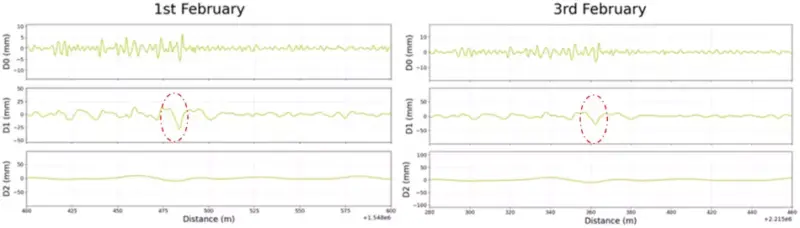
Figure 5: Comparison across repeated train measurements (200m). Significant amplitude in D1 range (Circled in red), showing at the 1st February (left chart) and at next measurement (right chart).
© Televic Rail
From signal to decision
- Single peak → possible transient or vehicle effect
- Repeated geo-localized peak → infrastructure condition
- Increasing amplitude → degradation trend requiring escalation
This structured interpretation enables actionable use in operations.
Multi-indicator correlation
Where available, track-response indicators can be combined with wheel-condition or wheel-impact data. This creates a multi-layer detection approach within a single system:
- Track response → identifies location
- Wheel condition → provides independent confirmation
- Fleet recurrence → increases confidence
Key takeaway
COSAMIRA® demonstrates that:
- EN 13848-aligned indicators can be generated onboard in real time
- Measurements are consistent and correlated across repeated runs
- Localized defects can be reliably identified and confirmed
- Trends can be detected over time
- Multiple indicators can be combined to accelerate decision-making
The system therefore provides operationally actionable information, not just monitoring data.
How continuous monitoring applies to the Adamuz failure pattern
If the Adamuz failure sequence is confirmed broadly along current findings, it suggests that the infrastructure defect developed progressively rather than instantaneously.
In such cases, early warning signals are typically present before failure, even if they are not yet formally identified. As trains pass over the affected location, they may generate abnormal but repeatable responses such as localized track-response peaks or emerging wheel-impact indicators.
With conventional inspection methods, these early signals may remain unnoticed or uncorrelated between inspection intervals.
Continuous onboard monitoring changes the situation fundamentally: as multiple trains pass the same location, abnormal responses can be detected repeatedly within a short time frame. What initially appears as an isolated anomaly becomes a consistent, geo-localized pattern.
At the same time, additional indicators, such as wheel-condition or wheel-impact measurements, may begin to show anomalies on those trains. Combining these signals provides independent confirmation of a developing issue.
The combination of recurrence, location consistency, and multi-indicator correlation increases confidence in the findings, creating a window for action. In practice, this means more time to act before a defect leads to failure.
Operators can then respond, for example by applying speed restrictions, triggering targeted inspections, or temporarily isolating the affected track section.
No single technology can guarantee the prevention of a specific accident. However, earlier detection increases the range of available preventive actions and significantly reduces risk exposure.