The US High Speed Rail Conference (USHSR), held in Washington, D.C. from 12-14 May 2026, brought together industry leaders to discuss the future of high-speed rail in America.
High-speed rail can offer significant benefits in addressing congestion, enabling regional economic growth, widening access to housing markets, and improving mobility for millions of Americans. To leverage such potential, projects such as California High-Speed Rail and Brightline West are already being implemented in their respective states. However, the true vision and broader scope of these benefits arguably cannot be achieved without nationwide ambition and coordination.

A future Brightline West train
© Brightline
During the conference’s opening session, former US Transportation Secretary Ray LaHood emphasised that countries with established high-speed rail networks have developed them through sustained national investment, long-term planning, and political support, with a “vision for its people to ride on affordable, comfortable passenger rail.” He argued that a similar commitment is consequently needed in the US.
High-Speed Rail in China
Addressing a frequently cited comparison, Zhenhua Chen, PhD, from Ohio State University, spoke at the conference regarding China’s implementation of its nationwide high-speed rail network. Chen acknowledged that China has consistently viewed high-speed rail as a national system with high demand due to its large population and dense mega-regions with long corridors. Currently, the country runs 31,000 miles of high-speed rail and aims to have 70,000 miles in service by 2035.
This implementation is aided by China’s centralised government and the scale of its economy, enabling widespread standardisation and reduced costs. Meanwhile, China’s focus on technology advances also contributes to progress, with CRRC set to roll out the world’s fastest high-speed train with the CR450.
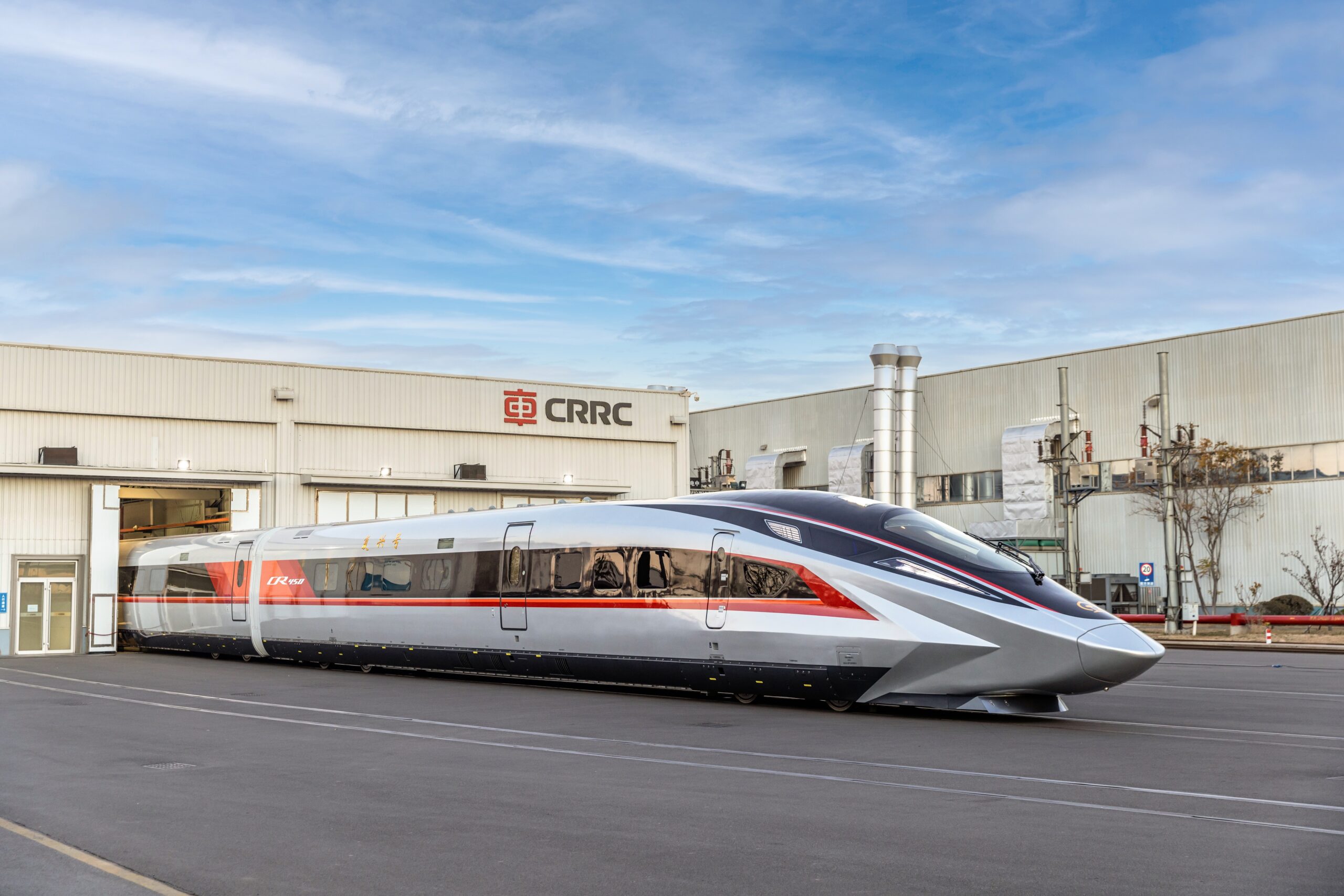
CR450 EMU Prototype
© CRRC
Chen stressed that the vision includes a nationwide timetable, service plan, and ticketing system, which aids both ease of use and efficiency. However, he also acknowledged that there are lessons to be learned from China’s experience and warned of the potential of overinvestment for lines that are not well utilised when implementing a nationwide network.
Meanwhile, although China is often cited as an example for how high-speed rail can be delivered, its approach is heavily impacted by its political system and procedures, which cannot be replicated in the US. Indeed, LaHood noted that delivery is not as straightforward in the US as in China, where “three people make the decisions”, and standardisation and cooperation are consequently more achievable.
Canada’s Alto Programme
It is thus perhaps more reasonable for the US to draw comparisons between itself and Canada, its northern neighbour. Canada is currently planning its first high-speed rail line, Alto, connecting Toronto, Ottawa, Montreal, and Quebec City along a roughly 1,000-kilometre corridor. Although a regional, rather than nationwide network, the programme reflects a significant level of federal involvement. The Canadian government has established Alto as a Crown corporation to oversee the project while working alongside its private delivery partner, Cadence.

With speeds reaching 300 km/h or more on approximately 1,000 km of dedicated and mainly electrified tracks, Alto will connect millions of people living along the Toronto–Québec City corridor
© Alto
At the USHSR Conference, Maria Luisa Dominguez from ALTO stressed that this combination of internal and external governance is key to resolving contradictions between provinces and ensuring the most effective decisions can be made. This reflects the benefits of national oversight and coordinated governance structures in delivering large-scale rail infrastructure projects.
Reflecting on the relevance of this project to the future of high-speed rail in the US, Andy Kunz, President & CEO of USHSR, expressed the hope that Canada’s implementation of high-speed rail and its government’s decisiveness in getting behind it will help likewise drive motivation in the US.
Indeed, the conference consistently emphasised the need for America to realise it is missing out on something it should be capable of delivering. For example, Keith Wilson, Mayor of Portland, OR, noted that Morocco has high-speed rail, despite having only 1% of the GDP of the US. The lack of this technology in the US therefore represents a shortfall that has negative implications for its people.
The Vision for US High-Speed Rail
One of the more notable themes to emerge from the conference was the growing effort to frame US high-speed rail as a long-term national infrastructure programme, similar to previous phases of American transport development. This is in contrast to its current form as a collection of isolated state projects.
Speakers such as Ezra Silk from USHSR and Chris Kopp from HNTB repeatedly drew parallels with the creation of the interstate highway system and the expansion of commercial aviation during the twentieth century. They argued that the US has historically responded to major shifts in transportation through coordinated federal planning and investment.
These infrastructure programmes succeeded because they established a federal framework defining the scale of the network, funding arrangements, governance structures and the division of responsibilities between national and local authorities. To replicate this success, the same attitude needs to be applied to high-speed rail, which should thus be viewed as a national priority.
To extend the benefits of high-speed rail nationwide, Kopp reasoned that the network would have to span 12,000 miles to serve 70% of the population. He noted that this would require less infrastructure than comparable systems in Europe or China, because the geography of major US population centres naturally forms interconnected regional corridors and triangular route patterns, reducing the need for longer grid-based alignments and allowing broader coverage with fewer route miles.
A national approach to delivering such a network would avoid the current issue of fragmentation. Unlike highways and aviation, high-speed rail in the US continues to depend on inconsistent state-level support and uncertain federal funding cycles, making long-term planning difficult.
Ed D’Amato from the Lakeshore Rail Alliance noted that currently, interstate rail projects move forward only when neighbouring states independently agree on priorities and funding. This creates uncertainties and inefficiencies that ultimately prevent Americans from leveraging the benefits of improved transport networks.
D’Amato said:
Every high-speed rail system in the world that’s been built has been accomplished because there’s a commitment from the national government. Right now, we have a state-led system, so a route gets built when one state feels like it, and when the states around it feel like it, because most of these routes are interstate in nature. States don’t always work together very well, and then there’s another layer of uncertainty because projects only move forward when Congress decides to fund them. We need a federal lead, because these are projects that operate in the national interest.
Delivering this Vision
To deliver this vision, Andy Kunz stressed the need to overcome the political divide, where rail, as a priority for one party, is seen as toxic to another. Conversely, by delivering nationwide benefits for both rural and urban communities, as well as both Republicans and Democrats, it should unite all Americans under a national narrative.
These benefits are reinforced by wider geopolitical and economic pressures, including recent increases in aviation fuel costs, which highlight the need for more stable and economically sustainable transport systems in the national interest. As high-speed rail offers a more stable, electricity-based alternative, it would provide greater insulation from fuel price shocks.
Indeed, during the Conference, a significant parallel was drawn with the Interstate Highway System, originally authorised as the “National System of Interstate and Defense Highways,” and thus explicitly framed around national resilience and defence. In this context, high-speed rail should likewise be understood as part of the US’ long-term infrastructure resilience plan of key national interest.

A rendering of a high-speed train in the Pacheco Pass in Santa Clara County, California
By adopting a national approach, several key benefits should also be delivered, including standardisation. Ezra Silk noted that in Canada, Alto is undertaking considerable planning for standardisation decisions before starting construction, and the US would need to do the same.
Currently, a lack of national standards for US rail is highly detrimental. For one, Phil Gilmour from US Rail Systems argued that it is difficult to attract private investment without these standards, as companies cannot rely on a consistent technical framework when assessing risk, cost, or long-term interoperability across projects.
Furthermore, Gilmour added that the absence of agreed national standards also increases capital costs and complexity during construction and operation. Without common requirements for systems such as signalling, rolling stock and rail specifications, projects risk creating isolated networks that cannot easily interoperate, limiting the efficiency of any future national system. This fragmentation ultimately slows delivery and weakens the case for a unified high-speed rail programme.
This is arguably a key lesson to be learned from Europe, which has had to spend billions addressing and reversing the effects of early fragmentation in technical standards across different national systems. Without early national standardisation and a federal lead, the US risks repeating these mistakes. With a coordinated framework in place, however, a scalable and interoperable high-speed rail network becomes significantly more achievable.
Convincing the Public
To gain consistent federal support for this nationwide vision, it is equally important to get the voters and public on board. This requires the narrative to be understood as beneficial and relevant to individual people and their lives.
In doing so, Michelle Boehm at Jacobs stressed the importance of making the benefits tangible. Rather than abstract arguments about networks or national productivity, the focus must be on lived experience: time saved in daily commutes, access to better jobs and housing markets, and the ability to move between cities quickly enough to reshape how people structure their lives. In this framing, high-speed rail becomes less about transport infrastructure and more about quality of life and opportunity.
Equally important is the role of storytelling and social proof. Kopp acknowledged that the majority of Americans don’t travel to see the positive impact of high-speed rail abroad, so education in the US is crucial. Jeff Joines from the BMWED-Teamsters Rail Conference argued that this can, in part, be achieved by centring workers, apprentices, families, and local communities as the protagonists, with visible projects demonstrating real-world benefits as they are built. Union participation, local job creation, and community pride were all identified as mechanisms that turn abstract support into a visible effect, where people see friends, neighbours, and colleagues directly benefiting and therefore become more likely to support the wider programme.
The panellists acknowledged that in the current political age, arguing in favour of environmental stewardship can discourage people from supporting a project. However, they also stressed the need for people to understand that here, the environmental movement is about providing something good, rather than taking away something considered ‘bad.’ With fuel prices rising, Americans are now being denied access to affordable, efficient mobility, which people elsewhere in the world benefit from through high-speed rail.
Robert Creamer, Partner at Democracy Partners said:
One of the key principles of great political communication is the understanding that it is always easier to mobilise people around something being taken away from them, then it is to something which they aspire… How do we engage a message that engages people’s feelings that something is being taken away from them if they are denied access to the same high-speed rail that is available to millions of other people around the world?
Can’t we do it in America? They do it in China, and they do it in France and in Spain. But we are being denied access to something that people really need, and they’re instead making you sit in traffic.
Crucially, Boehm argued that to convince the public of these facts and benefits, progress needs to be delivered more efficiently and within a single generation, rather than spanning multiple generations. It is therefore critical to dismantle and reduce the current barriers to effective delivery.
Overall, the conference’s message emphasised the need to align political will and governance into a coherent national effort capable of delivering a built reality for high-speed rail across the country. If such an alignment can be achieved, the US could demonstrate how large-scale infrastructure is conceived and delivered in a modern federal democracy.
Stay tuned for a dedicated editorial on how more effective delivery can be achieved to help this vision succeed.
Read more from the USHSR Conference