At last week’s USHSR Conference, Ian Choudri, CEO of the California High-Speed Rail Authority, provided a project update focused on construction delivery, procurement reform, and private-sector partnerships.
Earlier this month, the project proposed key changes to construction sequencing, funding strategy and delivery timelines to allow key tunnel sections towards San Francisco and Los Angeles to begin before completion of the currently mandated Central Valley segment.
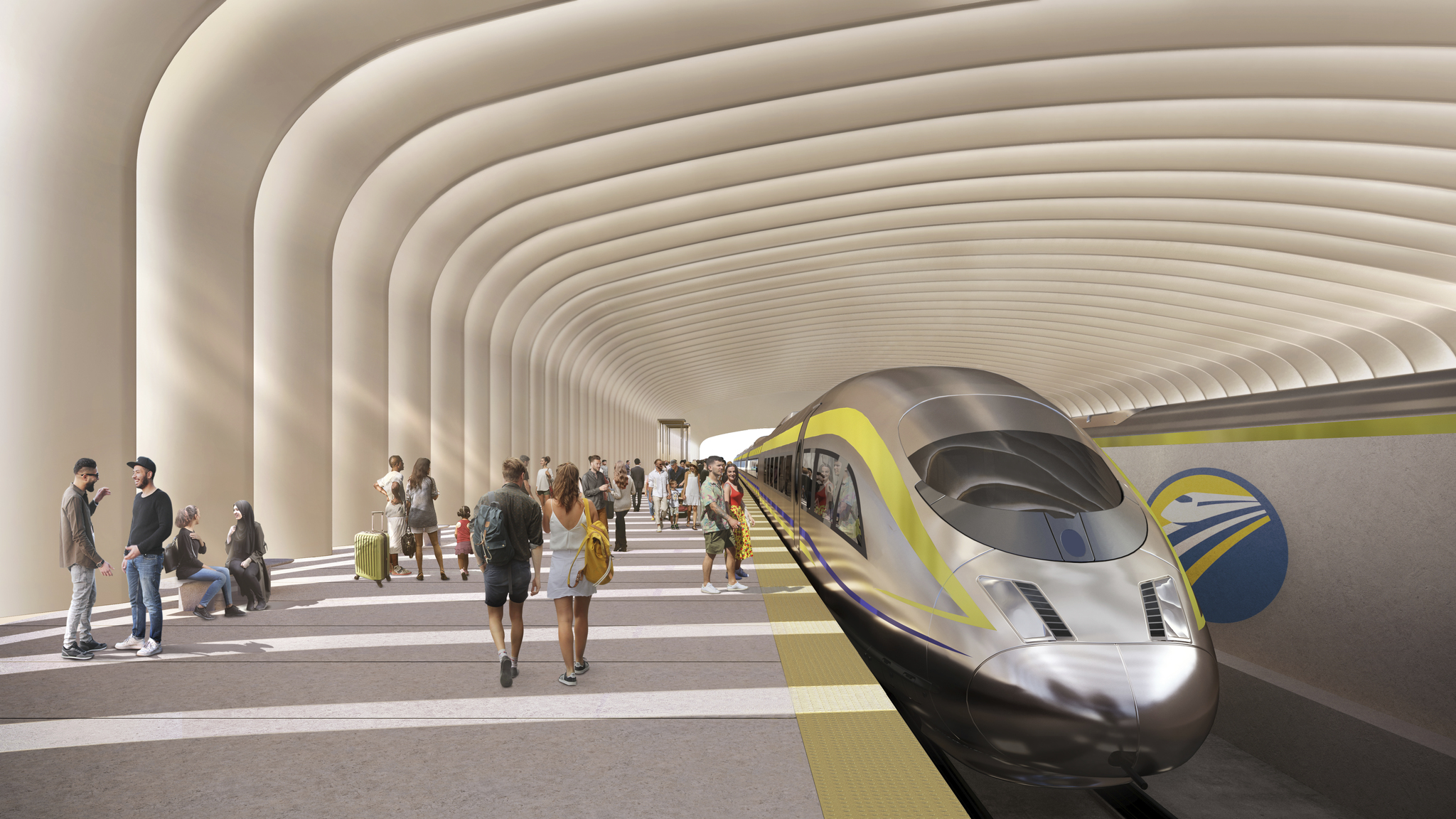
California High-Speed Rail
© State of California
The revised approach would also permit early services to operate on single-track infrastructure designed for later expansion, replacing the existing requirement to complete a fully double-tracked Central Valley route.
Three delivery scenarios are proposed, depending on future state funding commitments. The first would complete the Central Valley section only, with services beginning in 2033. A second option would extend the line north towards the San Francisco Bay Area by 2039, while a third would deliver the full San Francisco–Los Angeles corridor by 2040 through additional tunnels, new track and upgrades to existing commuter rail infrastructure.
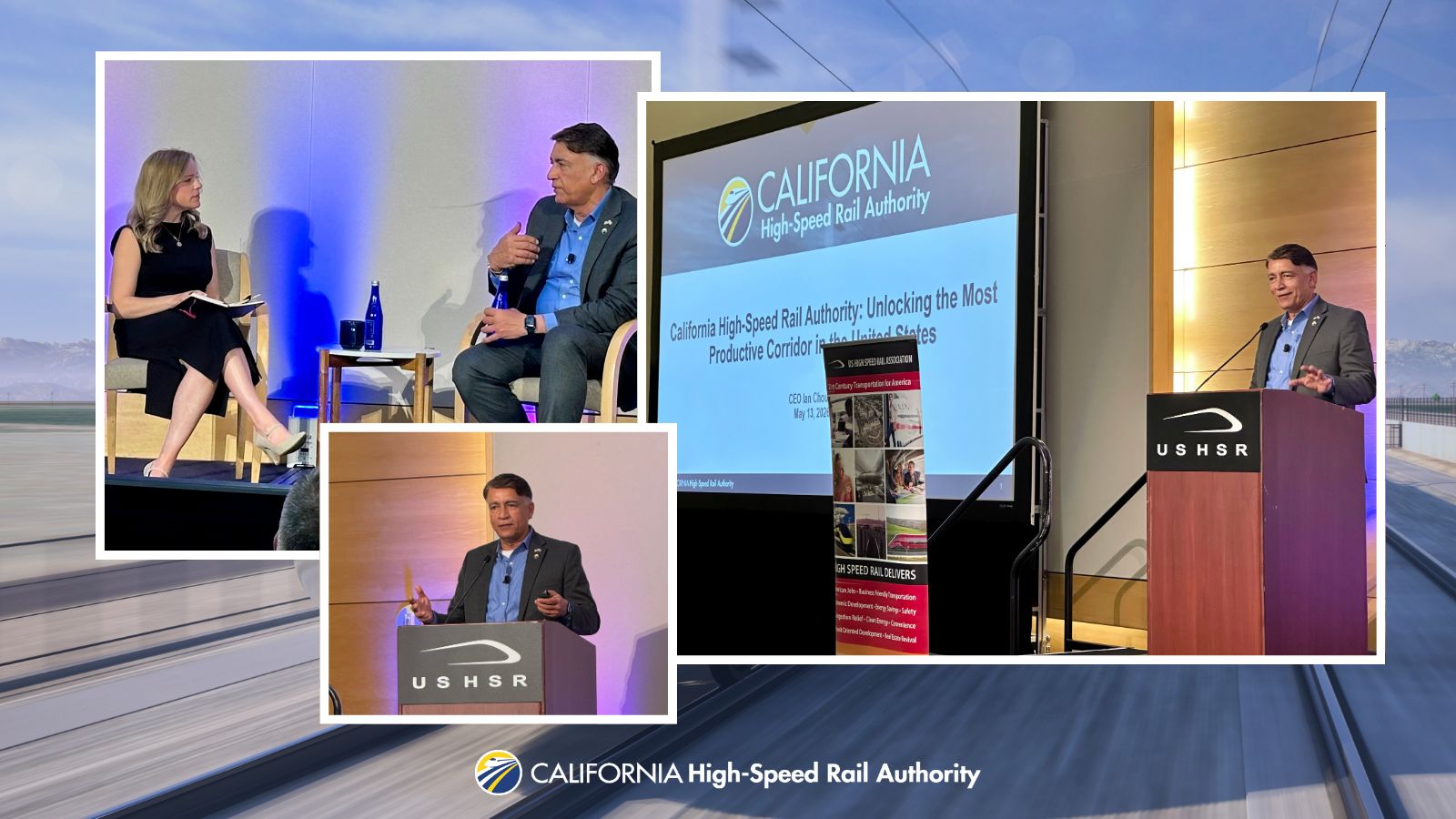
Ian Choudri, CEO of the California High-Speed Rail Authority at the USHSR Conference
© California High-Speed Rail
At the conference, Choudri discussed this revised strategy in an interview with CNBC’s Jeniece Pettitt.
He noted that the authority’s current focus remains the initial Central Valley operating segment, where approximately 120 miles are under active development. Of that, roughly 80 miles are expected to be ready for track installation soon. He stressed that the project is now advancing physically rather than conceptually, pointing to visible construction progress, including bridges, guideways, embankments, and tunnel work.
Choudri said:
The project is moving forward in a very physical way. It’s not on paper, it’s not concepts. It is the work that is being carried out physically.
A major component of the new strategy is a phased delivery approach. Here, the authority plans to sequence infrastructure according to operational need. This includes constructing only the amount of track, station infrastructure, and supporting assets required for early service levels while preserving the full corridor footprint for future expansion.
Under this approach, the authority would preserve land and design infrastructure for the final long-term system configuration, but defer some additional tracks or facilities until ridership and operational demand justify them. Choudri argued that this reduces unnecessary maintenance costs and improves capital efficiency during the system’s early years.
The authority has also revised several engineering assumptions to lower costs. Updated design criteria, including adjustments to rail grades and alignments, reduced tunnel requirements by approximately 14 to 16 miles in some sections. Meanwhile, the business plan incorporates greater use of existing transportation corridors in urban areas, including blended operations with already electrified systems such as Caltrain in the Bay Area.
Procurement Changes
According to Choudri, the authority determined that previous procurement structures were too slow and applied the same administrative processes to small purchases and major construction packages. The agency has since introduced new contracting mechanisms using IDIQs (indefinite delivery, indefinite quantity contracts) and multiple-award task-order contracts designed to shorten procurement timelines and accelerate project delivery.
The authority has also shifted toward direct purchasing of critical construction materials. Rails, concrete ties, poles, wire systems, fibre infrastructure, and related commodities are now being procured centrally by the authority itself rather than individually by contractors. Choudri said this approach reduces supply-chain risk and allows contractors to focus primarily on installation and construction.
Choudri remarked:
We decided we are going to purchase all this material ourselves… contractors can go run into our warehouse like a Home Depot… take it and go build.
The agency is simultaneously advancing several major procurements. Choudri confirmed that negotiations are underway with a future program delivery partner and that proposals for track and systems contracts have already been evaluated. He said he expects agreements to move toward board approval in the near term.
Private Investment
Private investment now also plays a much larger role in the authority’s long-term strategy.
Choudri noted that recent state funding commitments have helped create the financial stability necessary to attract private-sector interest. He described ongoing discussions with infrastructure investors, renewable energy developers, telecommunications providers, and potential co-development partners.
Rather than viewing high-speed rail solely as a passenger transportation system, the authority’s updated business plan treats the corridor as a broader infrastructure platform. Choudri outlined several areas under consideration for commercial development, including station-area projects, broadband infrastructure, renewable energy generation and transmission, concessions, and logistics opportunities.
He referenced international high-speed rail systems in countries such as Japan, Italy, Spain, France, and Germany, arguing that profitable rail networks globally rely on diversified infrastructure revenues rather than ticket sales alone. California’s long-term financial model similarly depends on monetising corridor assets beyond passenger fares.
The authority is also exploring energy partnerships tied to the rail network’s electrification. Choudri said the system will initially rely on existing utility infrastructure while simultaneously developing a renewable energy strategy capable of supporting rail operations and potentially broader community energy needs through private investment structures.
Los Angeles to San Francisco
Crucially, the updated business plan evaluates pathways for delivering the full Los Angeles-to-San Francisco system. Choudri stated that the authority has studied multiple expansion scenarios and concluded that a complete Phase 1 buildout could potentially be achieved by 2039 under an expanded financing and delivery framework.
He emphasised that the authority is now open to multiple partnership structures and delivery models rather than limiting development to a single procurement path. That flexibility, he said, could allow work to proceed simultaneously in different regions if financing and commercial structures align.
Throughout the discussion, Choudri repeatedly framed the project as part of a broader effort to establish a modern high-speed rail industry in the US. He called for greater domestic manufacturing capacity for rail materials and systems, streamlined permitting and utility coordination, and stronger collaboration between federal, state, and regional agencies.
Choudri said:
I hope one day federal and state partners become so united that it doesn’t matter who is in Washington or who is in Sacramento. They just look at it as: this is important American infrastructure, this needs to be built, let’s support it, let’s get it done, and then make an example out of it so we can build more.
He also encouraged local and regional transportation agencies to leverage California High-Speed Rail’s procurement work, supplier relationships, and contract structures rather than duplicating negotiations independently. According to Choudri, shared procurement strategies could lower costs and accelerate rail development across the country.
While acknowledging the project’s complexity and the challenges, Choudri argued that the current phase represents a turning point centred on execution, delivery, and long-term commercialisation.
Read more from the USHSR Conference: