Inglas may not be a household name, but its Impact Sentinel system quietly protects railways from Switzerland to Scotland. Railway-News spoke with Ryan Anderson, CEO of INGLAS, about how the company began and why seconds matter when nature meets infrastructure.
Railway-News: For readers who might not know you yet, how would you describe Inglas and the problem you set out to solve for the rail industry?
Ryan Anderson: Fundamentally, Inglas helps rail operators make faster, safer decisions when natural hazards strike.
Rockfalls, landslides and avalanches often happen without warning, particularly in mountainous or exposed areas. The challenge isn’t just knowing something has happened, it’s knowing quickly enough to do something about it. So, from the start, our focus has been on real-time alarming that gives operators those vital seconds to stop trains, close lines or activate safety systems before a situation escalates.
RN: Can you tell us how the company started and how its work has evolved?
RA: Inglas began developing the Impact Sentinel system in the mid 2000s as Swiss Federal Railways (SBB) was looking for a way to apply an automatic alarm when rockfall barriers were impacted – not minutes later, but immediately.
We worked closely with infrastructure and geotechnical partners to develop and test early systems, and by 2008 the first installations were live. In 2009, a major rockfall was detected that would otherwise have resulted in a train collision. That moment validated the entire concept.
Since then, the technology has evolved through several generations, but the guiding principle has stayed the same: keep it robust, keep it fast and keep it reliable in real-world conditions.
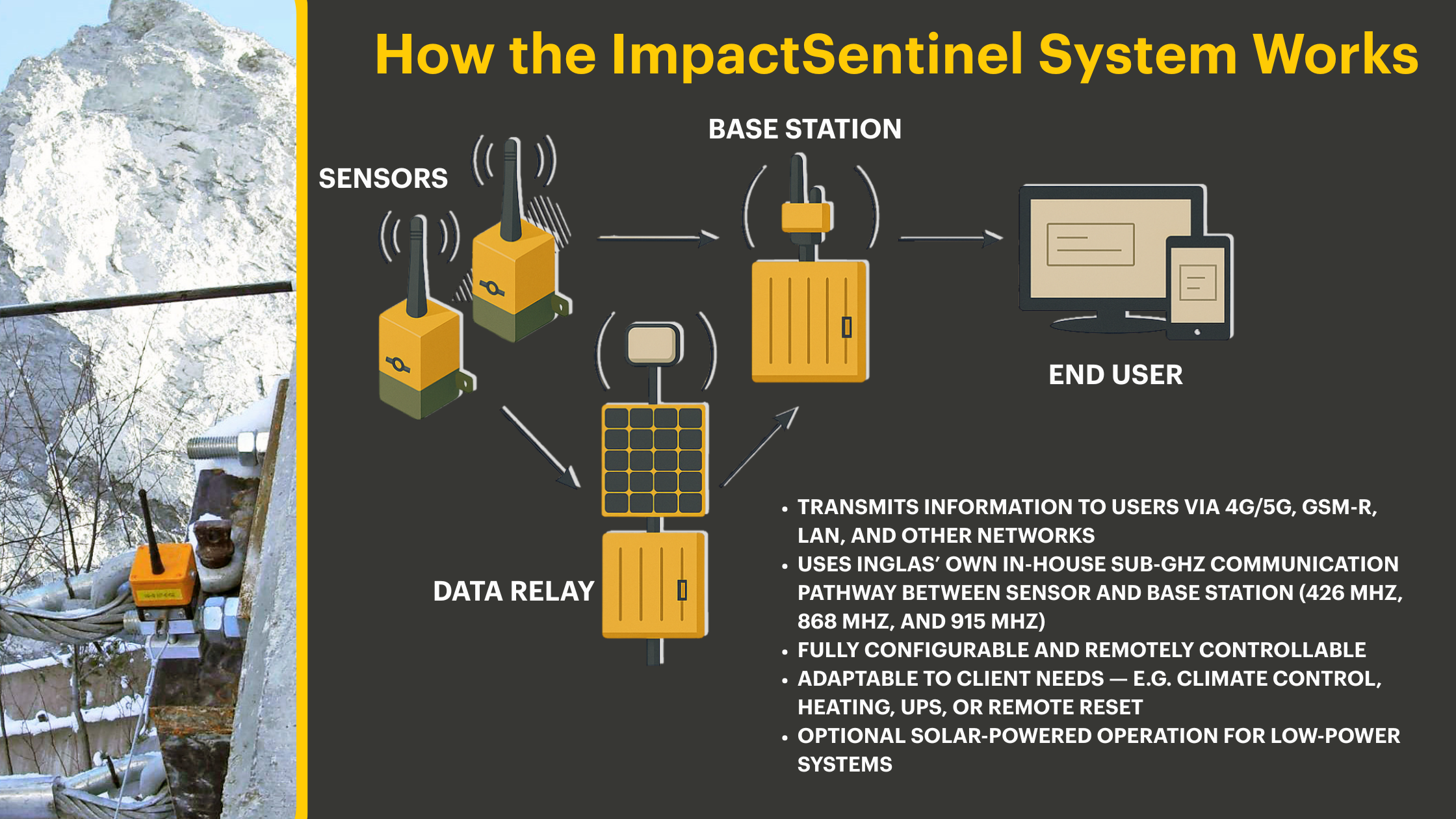
How ImpactSentinel works
RN: What are the biggest challenges railways face today when it comes to natural hazards and monitoring?
RA: Railways are operating in increasingly difficult environments. Extreme weather is more frequent, slopes are less stable, and many routes leave little margin for error.
At the same time, operators are under pressure to minimise disruption and avoid false alarms. One of the biggest challenges we see is over-complexity – systems that promise prediction or wide-area coverage, but struggle when conditions are at their worst. In safety-critical environments, reliability matters more than sophistication.
RN: Where does Inglas fit into that picture, and how does your solution work in practice?
RA: We focus very clearly on the point of impact.
The Impact Sentinel system is mounted directly on physical hazard barriers such as rockfall nets or fences. When those structures are struck or move in a meaningful way, the system reacts immediately.
Each sensor uses multiple detection methods working together, and decisions are made locally at the sensor itself. That means alarms are sent straight to operators without long processing chains or external dependencies, which is essential for live rail environments.
RN: You emphasise real-time monitoring. What does ‘real time’ actually mean for you?
RA: For us, real time means seconds, not minutes. Typically, an alarm reaches the operator within two to four seconds of an impact. That difference is critical. It’s the gap between being able to intervene and simply being informed after the fact. In an emergency, railways don’t need more data, they need clarity and speed.
A lot of monitoring systems can take five to twenty minutes, and sometimes even longer, because they depend on public infrastructure like 3G/4G/5G networks, satellite links or an external cloud to process data and then relay an alarm.
Our approach is different. Impact Sentinel has its own built-in telecommunications pathway: the sensors send a telegram via sub-GHz radio directly to our base station, and the base station then forwards the alert straight to the operator/authorities. Because we don’t rely on third-party networks or cloud processing, we remove the delays, which means operators get the information fast enough to act when it matters.
RN: Can you share an example where the system made a clear difference?
RA: A recent example in Switzerland stands out. During a severe storm, a radar-based monitoring system in the area became unreliable due to weather conditions. The Impact Sentinel sensors continued operating as normal.
When a rockfall occurred, the system automatically triggered the safety protocol and closed the route. No manual intervention was required, and no decisions had to be made under pressure. The system did exactly what it was designed to do.
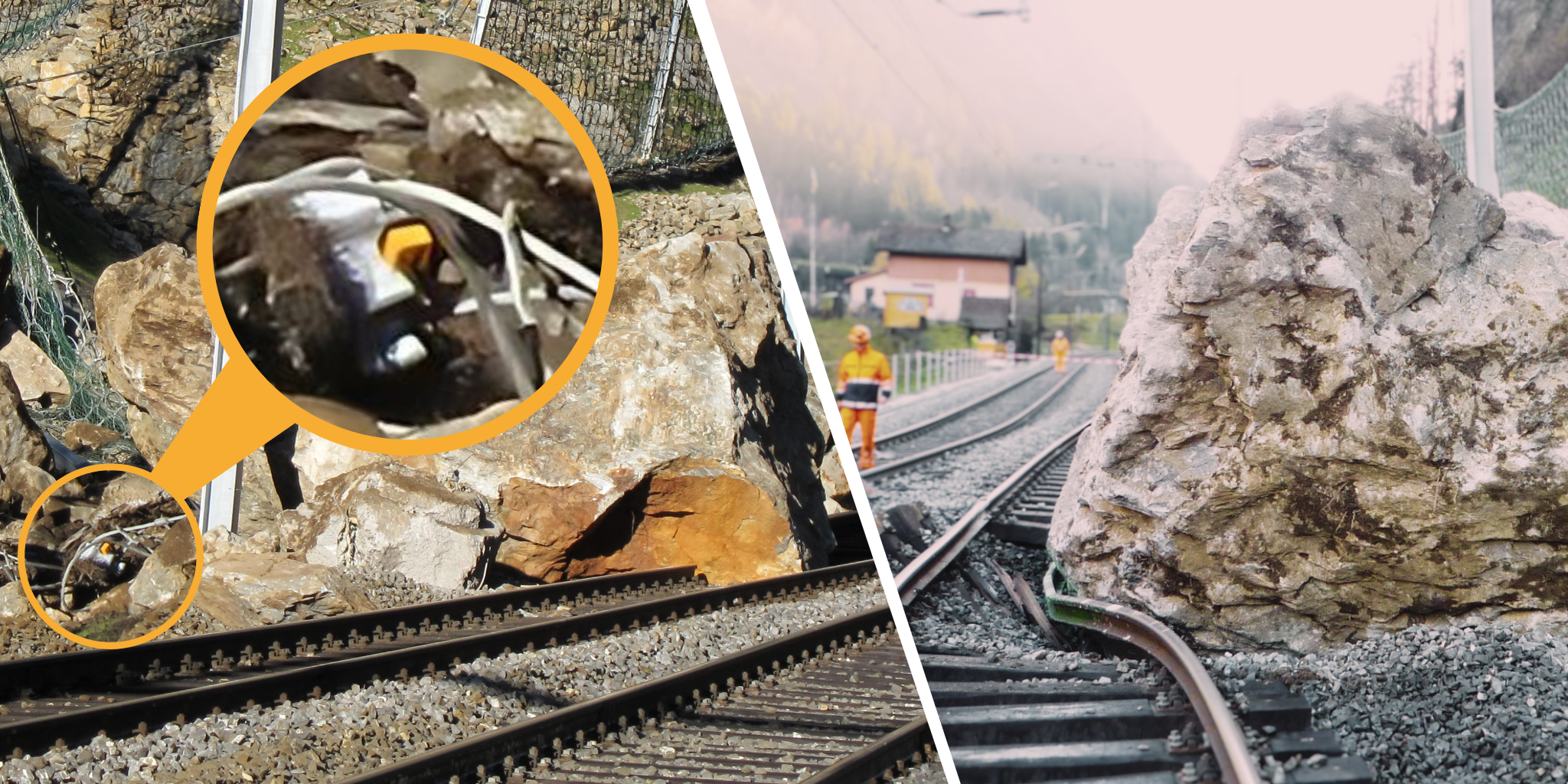
A rock fall in Switzerland
RN: When a customer comes to you with a risk or problem to solve, what does a typical engagement look like – from the first conversation through to installation and long-term support?
RA: Typically, it starts with a joint risk assessment, where we gather site details and review the customer’s existing protection measures. We then tailor an Impact Sentinel solution to their needs, including optional integrations like slope monitoring, cameras or warning lights.
After purchase, we install and commission the system on site, then train the team so they can operate it confidently. From there, we aim to provide long-term support that starts with an initial project and grows into a customisable, problem-area-focused solution.
Because climates and environments change in rail corridors, we’re also used to helping customers adapt quickly and efficiently as new risks emerge. In fact, some clients have started with a single project and now have 28 active safety installations across their network.
RN: You’ve chosen a model where customers own the system rather than paying ongoing subscription fees. Why was that important?
RA: Rail infrastructure is planned for decades, not product cycles. We felt strongly that safety systems should be owned, not rented. Operators want predictability, control and long service life, especially for critical infrastructure. Avoiding mandatory SaaS-style subscriptions allows the system to fit naturally into how rail assets are procured and maintained.
RN: There’s a lot of talk about AI and digital twins these days. How do you approach new technology?
RA: We’re pragmatic. If a technology genuinely improves reliability, response time or safety, we’re interested. But we’re cautious about adding complexity for its own sake. In safety-critical environments, simple and proven often beats clever but fragile, and that philosophy guides many of our design decisions.
RN: Finally, how do you see rail hazard monitoring evolving over the next decade?
RA: We’ll see more integrated systems and smarter analysis, but real-time alarming will remain essential. Our aim is to remain the dependable layer operators trust when conditions are at their worst – the system that works quietly in the background until the moment it’s truly needed.
Find out more about the Impact Sentinel system, or contact Inglas to discuss how they support your network.