Indian Railways continues to expand the Vande Bharat Express network as part of its wider effort to modernise inter-city rail travel.
164 Vande Bharat services are currently operational nationwide, covering 274 districts and carrying more than 75 million passengers since its launch in 2019.
Introduced as India’s first indigenously designed semi-high-speed trainset, the Vande Bharat Express is intended to reduce journey times on medium-distance routes while improving passenger comfort and safety. The trains feature self-propelled technology, regenerative braking, automatic doors, modern air-conditioning, bio-vacuum toilets, and onboard safety systems including KAVACH, India’s Automatic Train Protection system.
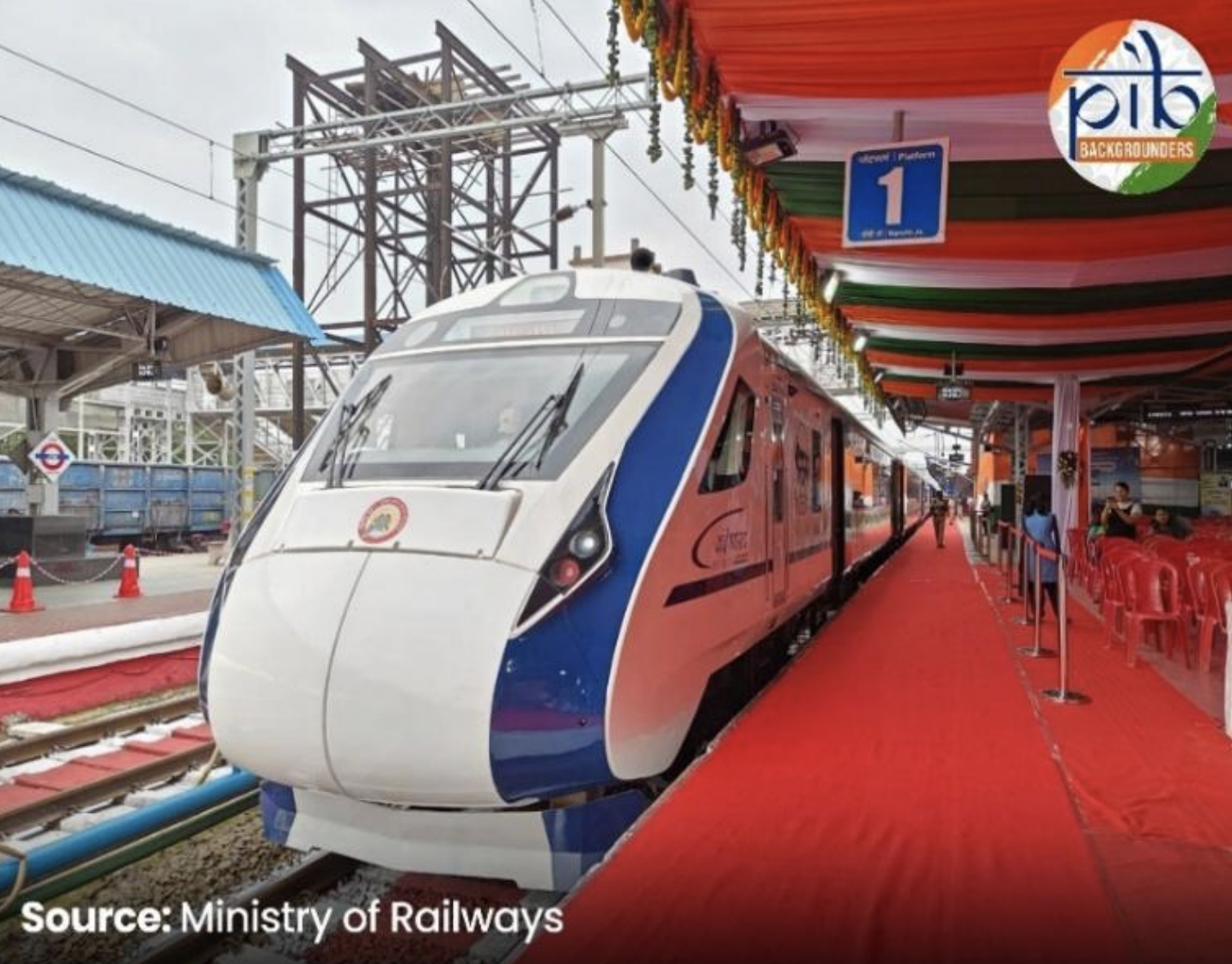
Vande Bharat Express
Journey times on several routes have been reduced by up to 45 percent. For example, the New Delhi–Varanasi service now takes around eight hours. Passenger demand has remained strong, with average occupancy exceeding 100 percent during 2024–25 and 2025–26 (up to June 2025).
Upgraded versions of the trainsets have been introduced in phases. Vande Bharat 2.0, launched in 2022, offers improved energy efficiency and higher design speeds, while the current 3.0 generation provides faster acceleration and updated onboard systems. A further iteration, Vande Bharat 4.0, is under development and is expected to be introduced within the next 18 months.
Indian Railways is also set to introduce the Vande Bharat Sleeper this month, extending the platform to long-distance overnight travel. The first service will operate between Howrah and Guwahati, reducing travel time by an estimated three hours compared with existing trains. The 16-coach, fully air-conditioned sleeper trainset has completed trial runs and certification.
Looking ahead, Indian Railways plans to operate around 800 Vande Bharat trainsets by 2030, with a long-term vision of scaling the fleet to approximately 4,500 by 2047, subject to infrastructure readiness. The programme forms a key component of India’s strategy to strengthen rail connectivity and support sustainable transport growth.