The West Coast Main Line has officially reopened following the completion of multiple journey improvement projects.
Passenger services along the northern half of Britain’s mixed-use passenger and freight route resumed today (15 January) after 14 days of essential upgrades, the biggest of all being the replacement of a 4,200-tonne, 130-metre-long bridge over the M6 just south of Penrith in Cumbria.
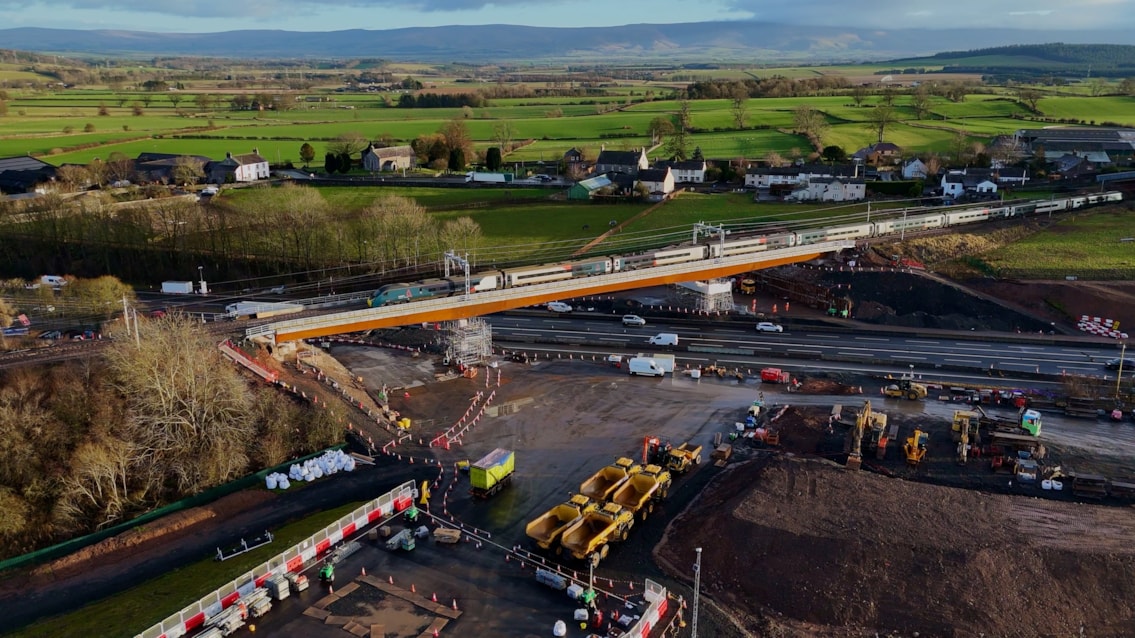
Service resumed along the route today (15 January)
© Network Rail
Work on the 60 million GBP structure was carried out over the course of two weeks, which saw the closure of two of Britain’s busiest transport routes – both the West Cost Main Line and the M6.
The motorway was closed between junctions 39 and 40 for the first two weeks of the year in order to allow Network Rail and principal contractor Skanska to demolish and then subsequently replace Clifton railway bridge.
Certain points of the closure saw a 115-mile stretch of the West Coast Main Line completely free from train traffic, allowing Network Rail teams to carry out a number of additional journey improvement projects between Preston and the Scottish border, including:
- The completion of a 61 million GBP modernisation of railway signalling in Carlisle
- Replacement of nearly 70km of overhead lines which power trains through Shap and Tebay
- Installation of rockfall protection through Shap cutting
- New signalling gantries and signals installed at Preston station
- More than 60 other smaller upgrades
The upgrades also necessitated the use of a diversionary route along the line between Settle and Carlisle – for the first time in a decade.
Christian Irwin OBE, Network Rail Capital Delivery director for the North West and Central region, said:
We have used this vital 14-day closure to make the biggest possible impact on the West Coast Main Line with multiple major upgrades now completed. As a result of the hard work of hundreds of our colleagues, both passengers and our freight operators will have a more reliable railway for generations to come.
We have worked closely with National Highways and train operators to limit the disruption to road and rail users while the M6 bridge replacement has taken place. I’d like to thank them and local communities impacted by the diversionary routes and those close to our construction site while we carried out this project to secure the future of not one, but two nationally important transport links.