Drawing on more than 40 years of current collection expertise across metro and rail applications, Mersen engineered and industrialised one of the most technically advanced static charging collector solutions available today.
For decades, tramway electrification relied on overhead catenary systems. While effective, their visual impact was a cause for concern for some urban authorities, particularly when used in historic city centres and UNESCO heritage zones.
As authorities increasingly prioritised aesthetics and public acceptance, pressure grew to remove pantographs and overhead wires from tramways in aesthetically sensitive areas. In response, manufacturers and suppliers began to explore alternative power strategies that could maintain tram performance without compromising the urban landscape.
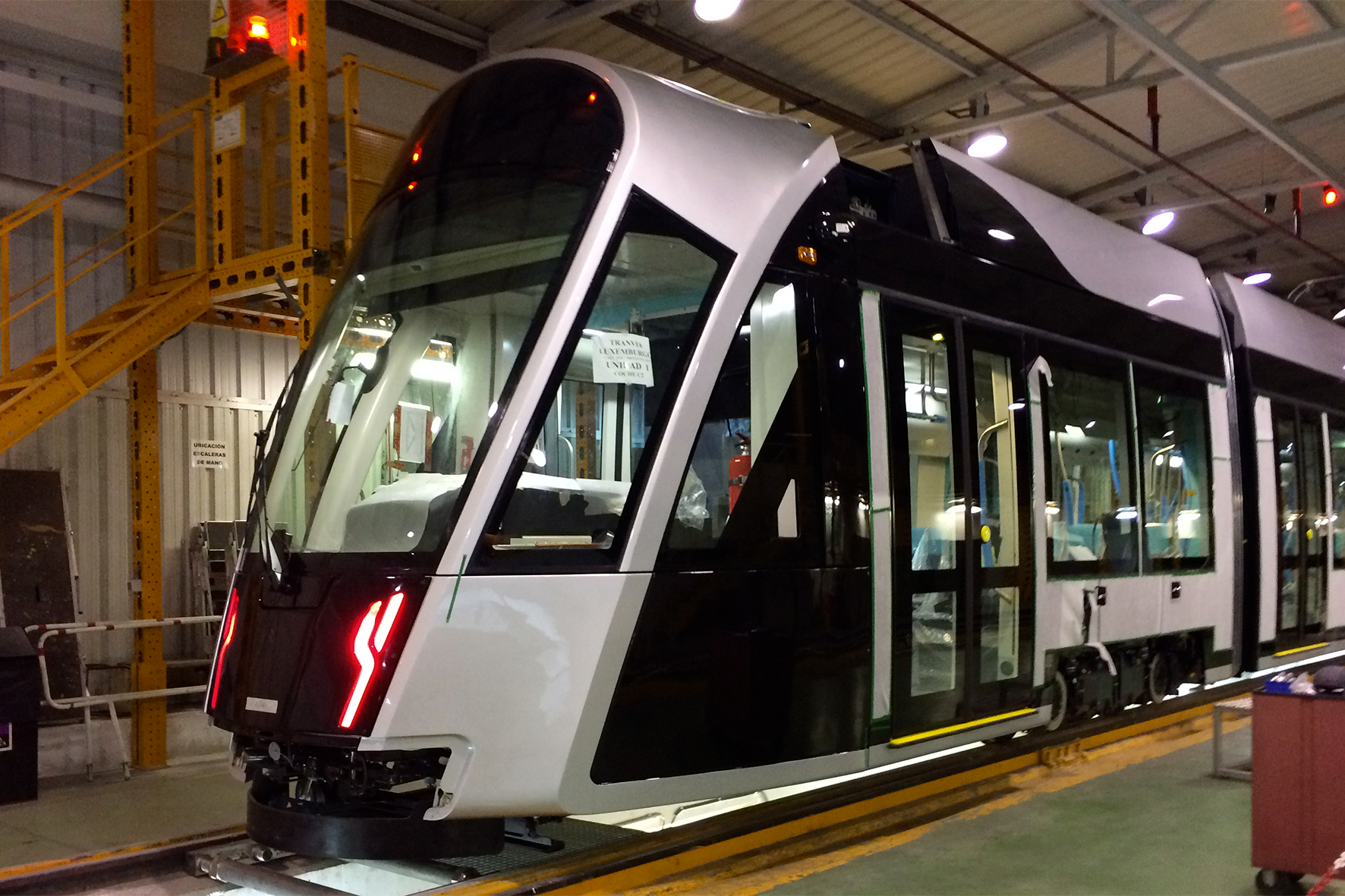
Model of Luxembourg tram
© Mersen
An Alternative in the Form of Ground-Based Power Collection
Ground-based power collection offered an attractive alternative, especially as it also reduced infrastructure costs. And so, in the early 2000s, Alstom developed a dynamic current collection solution for tramways where power was transferred from a ground-level third rail to the tram while it’s moving.
This was the sole ground-based solution for several years, until technology had evolved sufficiently enough for CAF to explore an alternative approach using onboard batteries combined with static charging at stations.
CAF approached Mersen to develop this new type of static current collector. While the company had decades of experience designing current collector devices (CCDs) for dynamic third-rail metro systems, static charging represented a fundamentally different engineering challenge.
Unlike dynamic collection, where contact is continuous and the vehicle is moving, static charging requires extremely high current transfer within a very short time window, under tightly controlled operational conditions.
Mersen’s first-generation static collector, developed approximately 15 years ago, was designed for current levels in the region of 800A. As onboard energy storage technologies evolved, particularly with the adoption of supercapacitor-based systems capable of absorbing much higher peak currents, the collector architecture had to evolve accordingly.
Its latest generation is capable of handling nearly double that original capacity: a progression that required optimisation of contact materials, mechanical stability and thermal performance to manage significantly higher current densities within short charging cycles.
For Mersen’s design office, this wasn’t simply an adaptation of an existing product, but the development of an entirely new collector architecture, optimised for high-current, short-duration energy transfer and repeated deployment cycles in urban environments.
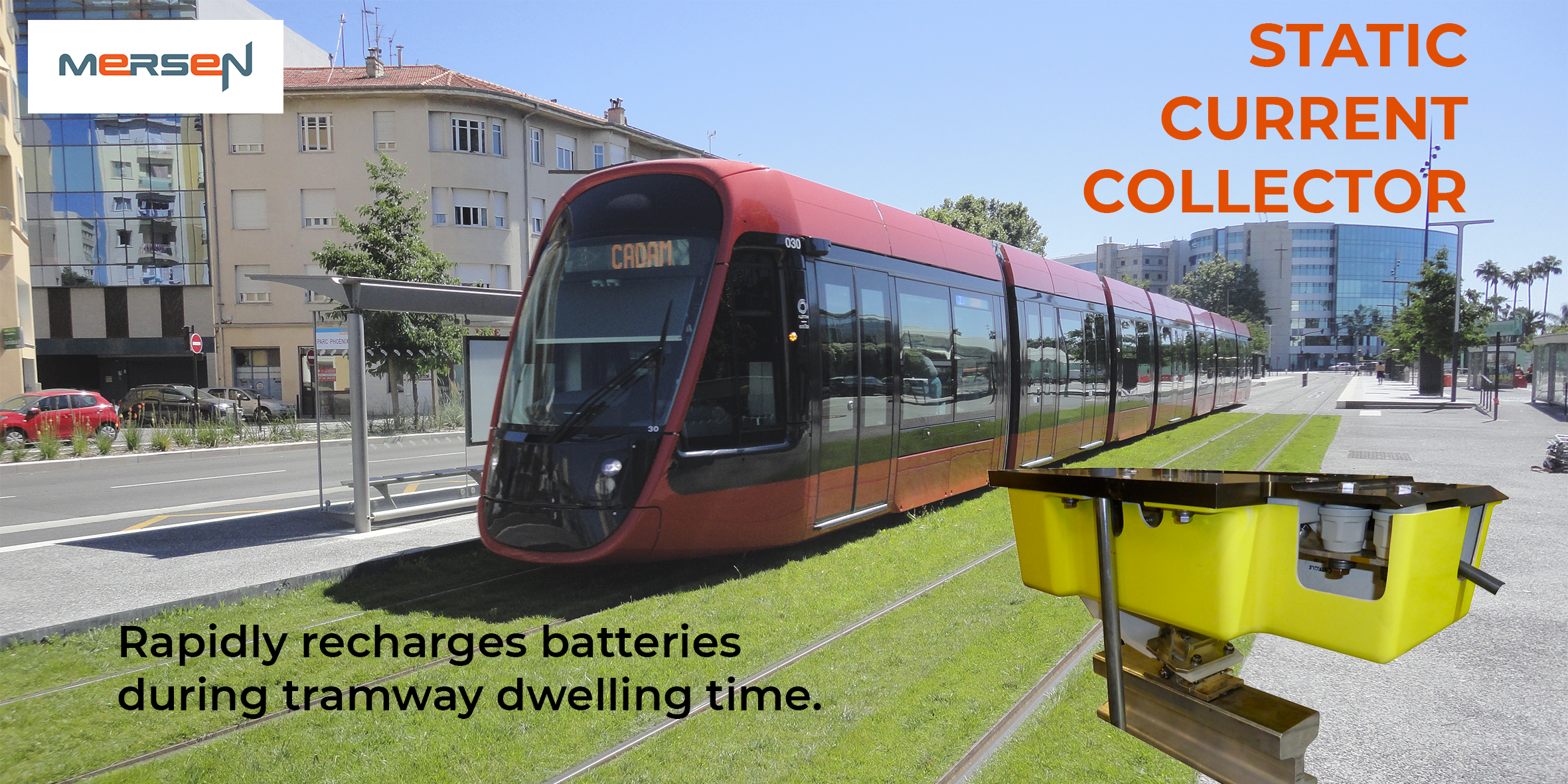
Mersen static current collector
© Mersen
How Static Charging Works
In a static charging system, a conductive rail is embedded in the ground at designated stations. Crucially, this rail is only energised when the tram is correctly positioned above it. A safety-controlled communication system between vehicle and ground infrastructure ensures that power is supplied only under strictly defined conditions.
Once stopped, the tram deploys its collector onto the charging rail. During passenger boarding and alighting, current flows from the ground rail to the onboard battery system. After the brief charging period, power is cut, the collector retracts and the tram continues to the next station.
Static charging can’t operate as a standalone product: it forms part of a fully integrated system designed to meet demanding railway requirements. Within this architecture, Mersen’s collector device is a critical technical component. Its mechanical reliability, electrical performance and precisely controlled deployment characteristics are essential to overall system performance, and its engineering teams work closely with OEM partners to ensure seamless integration of the collector within the wider charging architecture.
Engineering a High-Current Static Collector
Developing a static charging collector capable of transmitting up to 1,600A within a charging window of approximately 20 seconds required extensive modelling, simulation and validation work.
To ensure optimal sizing and thermal performance, Mersen’s engineering team used the numerical simulation platform COMSOL Multiphysics to model the coupled electrical and thermal behaviour of the collector head.
This enabled detailed analysis of current density distribution, contact resistance, transient heat generation and thermal dissipation during high-intensity charging sequences. By accurately modelling both electrical conduction and heat transfer, engineers were able to develop components precisely according to the transmitted current, ensuring controlled temperature rise and long-term durability. Mersen’s methodology was later shared within the COMSOL user community as an expert example of advanced multiphysics application in rail electrification systems.
Simulation formed only part of the validation process, however. The company’s large test facility in Saint Bonnet de Mure includes dedicated benches for current collection testing, and enabled engineers to validate mechanical behaviour, electrical performance and durability prior to deployment in revenue service.
Reliability in Revenue Service
While laboratory testing plays a crucial role, revenue service remains the ultimate benchmark. From the earliest deployments, Mersen adopted a hands-on approach, and real-world behaviour under passenger loading conditions quickly revealed subtle but important technical considerations.
Although the tram is stationary during charging, it’s not completely static. Passenger movement during boarding and alighting causes small vertical displacements of the vehicle, and these micro-movements can influence the contact interface between collector and ground rail. At high current levels, even minimal displacement can lead to variations in contact pressure, micro-arcing or accelerated wear.
Identifying and managing these effects formed a key part of the device’s development. Through on-site analysis and refinement of collector geometry and contact characteristics, Mersen’s engineers fine-tuned the system to ensure stable high-current transfer under real operating conditions.
In the absence of dedicated international standards specifically defining static tram charging collectors, operational experience has effectively shaped best practice. Over successive projects, Mersen has built a body of field knowledge that informs design improvements and performance optimisation, creating a practical reference framework grounded in real-world operation.
A Proven Solution
While static charging of tramways is a niche market, deployments across multiple continents have proven the reliability of Mersen’s solution across a wide variety of environments.
Its early involvement in the technology, combined with continuous engineering evolution and revenue-service validation, has positioned the company as one of the few suppliers worldwide able to demonstrate proven operational experience with high-current static collection systems. Today its static current collector is being used in many countries including Luxembourg, France and Spain in Europe, as well in Sydney’s Parramatta project.
One of its major current projects is in AlUla, Saudi Arabia, which is a high-profile tourism destination where preserving the natural and historical landscape is essential. Here the Alstom tram system will use static charging technology to transport visitors between arrival points and key sites, without the need for overhead poles or catenary lines.
Looking Ahead
As energy storage technologies continue to advance, charging strategies will evolve in parallel. However, the need for efficient, high-power transfer in constrained urban environments remains.
Backed by decades of current collection expertise, advanced multiphysics modelling capability and extensive revenue-service experience, Mersen’s static collector technology demonstrates how deep engineering know-how can translate into reliable electrification solutions for modern tram systems.
Mersen’s Train-Tram-Metro Rail Division is renowned for its expertise in current collection solutions and power transfer solutions for rail vehicles. Please contact the company to find out more.