Why rising expectations for platforms and footbridges are redefining manufacturing technology.
Rail lighting has quietly shifted from background utility to critical infrastructure. What was once specified primarily to meet minimum illuminance levels is now expected to support safety, digital connectivity, decarbonisation targets and long-term asset performance. Nowhere are these expectations more exposed than on platforms and footbridges, where lighting must perform reliably in harsh environmental conditions with limited maintenance access.
UK rail guidance formalises the performance baseline. RIS-7702-INS – Rail Industry Standard for Lighting at Stations defines requirements for station lighting design and operation¹. Complementing this, Network Rail’s NR-GN-CIV-200-08 Lighting Design in Stations guidance sets expectations around uniformity, environmental suitability and maintainability within operational contexts².
These documents describe what lighting must achieve. They do not dwell on how that performance is sustained for a decade or more in exposed rail environments. That responsibility rests with manufacturing technology.
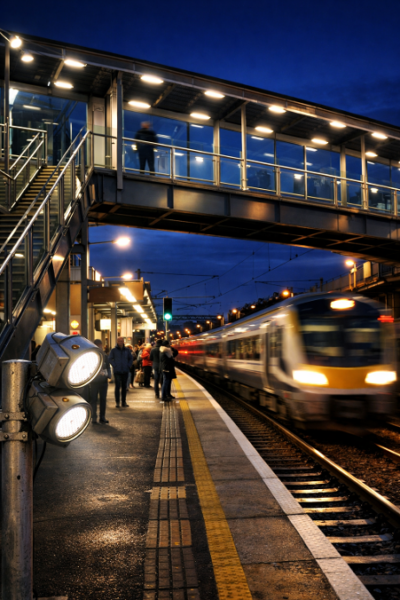
Lighting the future of rail infrastructure
© I-Vision Lighting Solutions Ltd
The widespread adoption of LED systems has delivered clear operational benefits. At Birmingham New Street Station, a major platform lighting upgrade reduced energy consumption while extending asset life through targeted replacement of lighting components rather than complete luminaire removal³. The sustainability narrative around such projects is well established. Less visible, but equally significant, is the manufacturing architecture that makes this possible. Modular construction, serviceable drivers and durable housings are not aesthetic refinements; they are engineering decisions made long before installation.
Digital integration is amplifying these demands. Intelligent lighting control, increasingly using open protocols such as DALI-2, enables remote fault reporting and energy optimisation. The Crossrail (Elizabeth line) lighting strategy demonstrates how integration, maintainability and system coordination were embedded into programme-level design requirements from the outset⁴. Connectivity introduces further manufacturing obligations: driver electronics must withstand thermal stress within sealed enclosures; firmware must remain stable across product generations; and configuration control must be robust enough to support long-term asset management.
Environmental exposure compounds the challenge. Platforms and footbridges are subject to wind-driven rain, UV radiation, vibration from rolling stock and public impact risk. Performance benchmarks such as BS EN 12464-2:2024 – Lighting of Work Places: Outdoor Work Places define required illuminance and uniformity levels⁵. Yet compliance at commissioning is only meaningful if those levels are maintained over time. Achieving high ingress protection and impact resistance ratings is not simply a matter of specification; it depends on manufacturing precision in sealing, material selection, assembly tolerances and validation testing.
The decarbonisation agenda adds further pressure. The Decarbon8 Whole System Rail Model highlights the contribution of infrastructure assets, including lighting, to operational and embodied carbon within the rail system⁶. Lighting influences both sides of this equation. Efficient driver and optical design reduce operational energy demand. Durable construction and modular serviceability reduce material waste and replacement frequency. As rail infrastructure is increasingly evaluated on whole-life carbon rather than capital cost alone, manufacturing robustness becomes a strategic consideration.
Traceability expectations are evolving in parallel. Rail operators increasingly expect clear documentation of component provenance, configuration history and long-term support planning. Electronics supply chains move faster than rail asset lifecycles, creating inherent tension between component obsolescence and infrastructure longevity. Managing that tension requires disciplined production systems capable of substitution planning, version control and sustained support.
The cumulative shift is subtle but decisive. Lighting in rail is no longer treated as a consumable fitting. It is managed as infrastructure — safety-critical, environmentally exposed and lifecycle-accountable. Platforms and footbridges, by virtue of their visibility and exposure, make these pressures most apparent.
Passengers experience illumination. Asset managers depend on reliability. What increasingly determines both is the maturity of the manufacturing systems behind the luminaire. As rail networks continue to modernise, the quality of light across platforms and bridges will reflect not only design intent, but the depth of engineering embedded in production.
Geoff Jones, Director, i-vision Lighting Solutions Limited
References
- RSSB, RIS-7702-INS – Rail Industry Standard for Lighting at Stations (Issue 1)
https://www.rssb.co.uk/standards-catalogue/CatalogueItem/ris-7702-ins-iss-1 - Network Rail, NR-GN-CIV-200-08 – Lighting Design in Stations (2024)
https://www.networkrail.co.uk/wp-content/uploads/2024/08/NR-GN-CIV-200-08-Lighting-Design-In-Stations.pdf - Q Sustain, New Street Station Lighting Retrofit
https://qsustain.co.uk/news/new-street-station-lighting-retrofit/ - Crossrail Learning Legacy, Lighting Design and Strategy for Stations, Shafts and Portals
https://learninglegacy.crossrail.co.uk/documents/lighting-design-and-strategy-for-stations-shafts-and-portals-on-the-crossrail-project/ - BSI, BS EN 12464-2:2024 – Lighting of Work Places: Outdoor Work Places
https://knowledge.bsigroup.com/products/light-and-lighting-lighting-of-work-places-outdoor-work-places-1 - Decarbon8, Measuring Railway Infrastructure Carbon – Whole System Rail Model
https://decarbon8.org.uk/wp-content/uploads/sites/59/2022/02/Measuring-Railway-Infrastructure-Carbon-report.pdf