Last week, the UK Department for Transport announced that HS2 Ltd will explore simplification measures, including potentially lowering its planned top speed. These proposals aim to reduce delays and overall costs.
An update on the proposals is expected this summer. Meanwhile, the industry has reacted to the announcement, expressing concerns regarding the potential cuts to the service’s top speed.
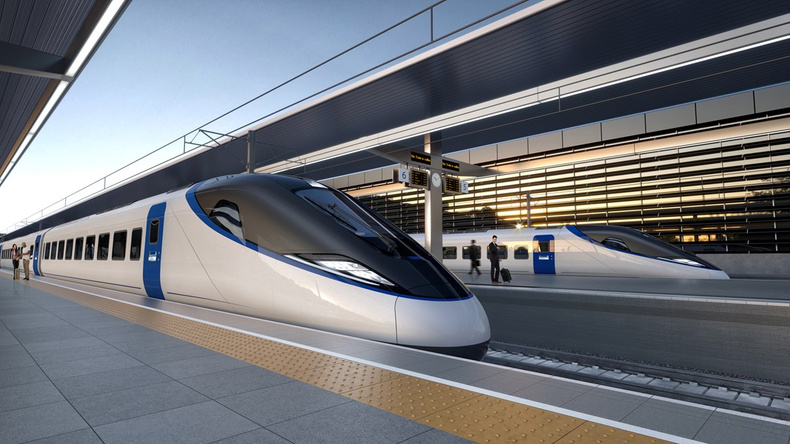
HS2 was designed to operate at speeds of up to 360km/h
© HS2
HS2 was originally intended to operate at speeds of up to 360km/h, positioning it as the fastest conventional high-speed rail system in the world. The TSSA union, which represents HS2 staff, has criticised proposals to scale back this ambition, describing the move as “very unwise.”
TSSA General Secretary Maryam Eslamdoust said:
I’m afraid this is a very unwise idea. HS2 must be safe but instead of offering a choice between further delays or reduced speeds Ministers should be seeking solutions now so that HS2 is running at full speed on day one.
Frankly anything else will leave Britain in the slow lane not just in comparison with other countries in Europe but also China. HS2 is vital because a vibrant growing economy in the 21st Century needs reliable high-speed rai links.
These proposals diminish our ability to grow local, regional and national economies, and therefore undermine what the government has long claimed as its top priority.
However, Mark Wild, Chief Executive of HS2 Ltd, noted that speed has never been the top priority for HS2, and pointed to the benefits to capacity, travel, and economic development that should be efficiently delivered.
As no railway in the UK or internationally is currently engineered to support speeds of up to 360km/h, testing of the new trains would only be able to take place once dedicated HS2 infrastructure is completed. This requirement risks adding further costs and delays to the project.
Mark Wild, Chief Executive of HS2 Ltd, said:
I made a commitment to the Transport Secretary that I would regain control of HS2 and bring an end to the project’s cost increases and delays.
With performance moving in the right direction, driven by the hard work of 30,000 people on the ground, we are rightly exploring options to create further efficiencies.
Speed has never been the primary objective. This railway will deliver better journeys, more capacity on the network, and economic growth – all of which are vital to the country’s future prosperity.
The DfT states that reducing the top speed would have only a negligible impact on journey times, while allowing services to begin sooner. It would also align HS2 with established high-speed networks such as HS1, Japan’s Shinkansen, and France’s TGV, which typically operate at speeds of 300–320km/h.
Following this announcement, the debate over HS2’s future direction is likely to intensify as the government weighs cost-saving measures. While proposals to simplify the project may help bring spending and timelines under control, this arguably risks compromising on performance.