In a previous article, we explored the case for circadian lighting in rail as a low-cost, practical opportunity to enhance passenger comfort and staff wellbeing. If the strategic case is now clear, the next question is more important: how should circadian lighting be implemented in real railway environments?
From principle to practice
Circadian lighting is not a theoretical concept. The biological effects of light are well understood, and the technology required to deliver tuneable, white, multi-channel LED systems is mature.
The real challenge lies in applying this understanding proportionately within the operational, safety and commercial realities of the rail sector.
Rail environments are diverse. A single solution is unlikely to be appropriate across stations, footbridges and rolling stock. Instead, implementation must reflect how each space is used, how long people occupy it and how safety systems are structured.
Starting Where It Is Simplest: Waiting and Rest Areas
Station concourses, lounges and staff rest facilities represent the most straightforward entry point.
These are generally unified spaces where a coordinated lighting scheme can operate on a programmed circadian profile throughout the day — cooler, higher-alertness tones during morning peak periods; neutral daylight conditions through midday; warmer tones in the evening to support winding down.
Such areas are not constrained by the same safety-critical control architecture as rolling stock. In many cases, circadian capability can be incorporated into planned LED upgrades under CP7 station improvement and asset renewal programmes.
The intervention is modest. The experiential improvement can be meaningful.
Rolling Stock: Working Within the Framework
The station environment, while not without its own constraints, is relatively uncomplicated compared to what comes next. Carriages present a more complex but more interesting challenge — and one that ultimately offers the greater opportunity.
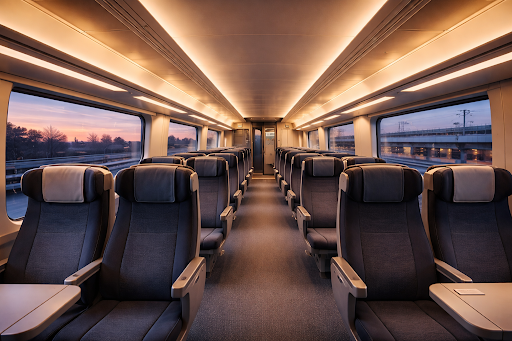
Most modern rolling stock operates with general carriage lighting governed by the Train Management System (TMS) to maintain safety compliance, alongside individual reading lights with basic on/off functionality. Any circadian strategy must work within this framework. Minimum illumination levels, emergency override functions, CCTV visibility and evacuation standards remain paramount.
Circadian lighting, therefore, cannot be layered on as a decorative feature. It must be integrated into the existing control architecture so that safety and operational integrity are never compromised.
The question becomes not whether the framework allows circadian lighting — but how intelligently it can be introduced within it.
First Class as a Pilot Environment
First class environments offer a logical starting point for onboard implementation. Passenger density is lower, lighting is typically more refined, and space constraints are less severe. Tuneable white systems can be integrated with relatively limited modification to existing layouts.
This provides a controlled environment in which circadian profiles, control interfaces and passenger response can be evaluated before wider deployment. It is a pragmatic rather than revolutionary step.
Standard Class: The Optics of Personalisation
In standard class, the design challenge becomes more nuanced. Higher density seating means that individual control risks disturbing adjacent passengers, and any personalisation strategy must avoid creating a patchwork of competing light conditions.
A layered approach provides a viable pathway. General carriage lighting follows a gentle circadian progression throughout the operating day, while localised passenger lighting offers limited, intuitive adjustment at seat level.
The enabling factor is optical control. By designing tightly focused, well-managed beams directed at individual seats or small seat groups, personal adjustment becomes possible without excessive light spill. This is not a conceptual hurdle — it is an optical design challenge, and one that modern LED systems are well capable of addressing.
Control Philosophy: Keep It Intuitive
Technology should not increase cognitive load. Two broad approaches exist, and the choice between them matters.
App-based control — integrated into a rail operator’s mobile app — reduces additional hardware and aligns with wider digital strategies. The drawback is friction: passengers must engage with a secondary interface at a point in their journey when many simply want to settle in.
A seat-integrated interface offering a small number of fixed options — a default circadian progression, a warmer setting for relaxation, a cooler daylight mode for working, and off — requires no behavioural learning and mirrors conventions passengers already understand from reading lights. In public transport environments, where diversity of user and context is high, simplicity consistently delivers the highest usability.
For most applications, particularly in standard class, seat-level control is likely to be the more effective approach. App integration may be better suited to premium or long-distance environments where passengers are already engaged with a digital service layer.
Safety and Compliance Remain Non-Negotiable
Circadian lighting in rolling stock must maintain minimum illumination standards at all times, integrate seamlessly with emergency override systems, preserve CCTV performance and visibility, and avoid any distraction to drivers or operational staff.
The general circadian programme would remain centrally controlled via the Train Management System, ensuring compliance and operational stability. Any implementation will need to be developed within the relevant approval frameworks — including engagement with rolling stock engineering teams and, where applicable, the processes governing modifications to safety-critical systems.
In this context, circadian lighting is not a competing system — it is a refined mode of operation within the existing one.
A Measured Path Forward
As outlined in the previous article, circadian lighting represents a proportionate opportunity within broader rail investment cycles. The same principle applies to implementation.
Rather than wholesale redesign, a staged approach is appropriate: introduce circadian profiles in waiting areas and lounges; pilot tuneable systems in first class; refine optical control and passenger interfaces for standard class. This aligns innovation with operational caution — a balance familiar to the rail industry.
Aligning Environment with Engineering
Rail has long excelled at optimising traction, signalling and control systems. Passenger-facing environments have traditionally been secondary to those priorities.
Yet as operators compete increasingly on comfort, service quality and experience — particularly on longer routes — the onboard and station environment carries growing strategic weight.
Circadian lighting is not an aesthetic upgrade. It is an application of established human-factor science using mature technology, integrated within existing safety frameworks.
The opportunity now is not technical feasibility. It is intentional design.
If Part 1 asked whether circadian lighting should be considered in rail, Part 2 asks a more practical question:
Are we ready to design passenger environments with the same systems-level thinking that defines the trains themselves?
This article was published by i-Vision Lighting Solutions.