Rail decarbonisation in the UK is rightly dominated by electrification and alternative traction. These interventions deliver the largest reductions in absolute emissions.
But they do not address everything.
A significant share of rail’s electricity use sits outside traction — in stations, depots and supporting infrastructure. Network Rail reports total electricity consumption of 449.1 GWh across its estate, illustrating the scale of this non-traction load. [1]
The question is how to tackle it effectively — and where to start.
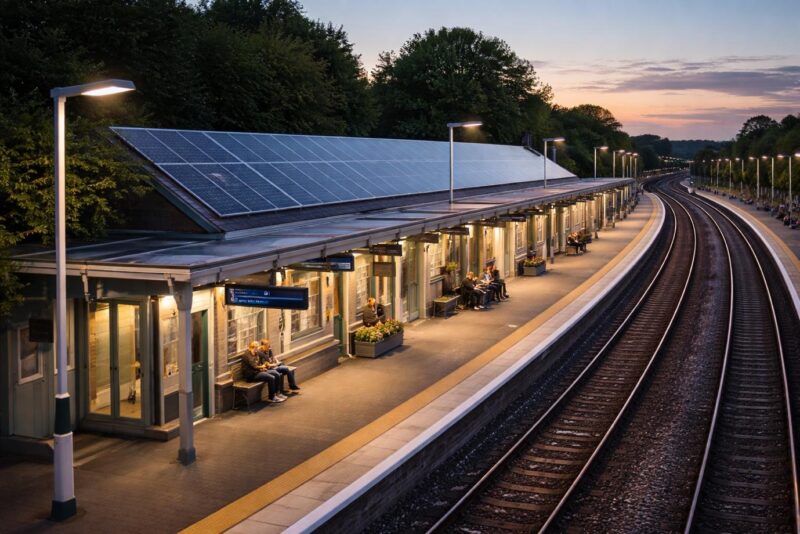
The overlooked majority of stations
The UK rail network is not primarily composed of major terminals. According to Network Rail station classifications:
- 248 Category C stations
- 298 Category D stations
- 695 Category E stations
That is 1,241 stations before considering F-category sites. [2]
These stations share three useful characteristics:
- Modest, repeatable energy demand
- Relatively simple infrastructure
- Large numbers across the network
This makes them suitable for a programme approach rather than isolated projects.
Start with efficiency, not generation
The most effective first step is reducing demand.
The Carbon Trust reports that LED lighting upgrades can typically reduce lighting energy use by 50–80%, depending on the starting point. [3] At smaller stations, lighting is often one of the dominant electrical loads.
Controls — such as photocells, timers and occupancy-based switching — reduce unnecessary runtime and typically deliver additional savings.
In combination, these measures can reduce total station electricity demand by around 20–50%.
Beyond energy: the passenger safety case
Lighting upgrades at smaller stations are not purely an energy intervention.
Research has linked poor lighting at stations to reduced perceptions of personal safety, particularly for women travelling alone at night. Department for Transport guidance on secure station design identifies lighting as a key environmental factor influencing perceived safety.
This matters for programme prioritisation. An intervention that simultaneously reduces energy use and improves the passenger environment has a stronger case for investment than one that delivers energy savings alone. At Category D and E stations — many of which are unstaffed — this case is particularly direct.
From individual sites to a portfolio
The impact becomes clearer when considered across the estate.
Two published rail examples provide useful anchors:
- A solar installation at Barking station generates ~99,700 kWh/year [4]
- The Blackfriars station roof generates ~900,000 kWh/year [5]
To estimate a portfolio, assume a modest, standardised system:
- Average system size: 5 kWp per station
- UK yield: ~800 kWh/kWp/year [6]
This gives ~4,000 kWh/year per station.
Applied across the 1,241 Category C–E stations identified above: 5 GWh/year total generation. A tiered approach (larger systems at Category C, smaller at D/E) reasonably increases this to 7–8 GWh/year. This is equivalent to roughly 50–76 Barking-scale systems, or around 5–8 Blackfriars roofs.
The key point is not the size of any individual installation, but the effect of repetition across many similar assets.
Efficiency first changes the outcome
If demand is reduced before generation is added:
- 20–50% of station energy use is removed upfront
- Solar systems can be smaller and better matched to demand
- A higher proportion of generated energy is used on site, improving value
Across Categories C–E, this implies: 1.5–3.5 GWh/year of avoided demand, plus 5–8 GWh/year of generation. Combined, this produces an overall impact of 6.5–11 GWh/year.
This remains a small fraction of total rail electricity use — but it is concentrated in the part of the system that other decarbonisation measures do not directly address.
Why this is still worth doing
This approach does not compete directly with electrification. It operates at a different scale and addresses a different problem.
It can be delivered quickly, uses mature technologies and applies consistently across a large number of similar sites. That makes it suitable for programme-based rollout through renewals and minor works, rather than major capital schemes.
It also improves resilience and reduces exposure to electricity price volatility, particularly at stations outside major urban centres.
The barriers are real — and need to be addressed
If this is straightforward to argue, the obvious question is why it has not been done systematically.
The barriers are structural. Responsibility for smaller stations is fragmented between Network Rail and train operating companies. Historically, franchising arrangements limited incentives for investments with multi-year payback periods; while these have now been replaced, decision-making remains distributed across multiple parties. Programme discipline across more than 1,200 assets is also genuinely difficult to maintain without a dedicated delivery mechanism.
These are not reasons to abandon the approach. But they are reasons why it requires deliberate programme design, clear ownership and sustained commitment rather than ad hoc project delivery. The industry restructuring now under way, including proposals for Great British Railways to consolidate infrastructure and operational accountability, may provide a more favourable environment for exactly this kind of coordinated initiative. [7]
A realistic view of its role
This is not a primary decarbonisation lever.
- It will not match the impact of electrification
- It will not eliminate grid dependence
- Its absolute energy contribution is modest
Its value lies in delivering incremental, low-risk gains at scale across the part of the network that is easiest to standardise and deploy.
Conclusion
The rail network is not primarily a collection of major stations. It is a long tail of smaller, similar assets.
Treating those stations as a coordinated energy programme — reducing demand first, then adding generation — creates a practical and scalable way to cut non-traction energy use.
Under conservative assumptions, this approach delivers 6.5–11 GWh/year of combined impact, equivalent to multiple flagship solar installations, but distributed across more than a thousand ordinary stations.
It is not the headline act in rail decarbonisation.
But it is a credible, deliverable layer that fits alongside the larger, slower interventions already under way — and one that doubles as a meaningful improvement to the everyday passenger experience.
References
[1]: Network Rail, Annual Report and Accounts 2023 (non-traction electricity context): https://www.networkrail.co.uk/wp-content/uploads/2023/07/Network-Rail-Annual-Report-and-Accounts-2023.pdf
[2]: Network Rail station category counts derived from the Better Rail Stations report (Department for Transport, 2009), authored by Chris Green and Peter Hall, which established the current A–F categorisation framework.
[3]: Carbon Trust, Lighting, Bright ideas for efficient illumination: https://www.carbontrust.com/sites/default/files/documents/resource/public/Lighting-guide.pdf
[4]: Photon Energy, Barking station solar case study: https://www.photonenergy.co.uk/c2c-rail-barking-railway-station
[5]: Network Rail, Blackfriars solar bridge: https://www.networkrailmediacentre.co.uk/news/worlds-largest-solar-powered-bridge-makes-britains-biggest-brew-for-commuters
[6]: Centre For Sustainable Energy: https://cat.org.uk/info-resources/free-information-service/energy/solar-photovoltaic
[7]: The Railways Bill: https://www.gov.uk/government/publications/railways-bill/railways-bill-introducing-and-designing-great-british-railways
This article was originally written by I-Vision Lighting Solutions.