During its public consultations, Canada’s proposed high-speed rail project, Alto, has addressed why the federal government opted for high-speed rail (HSR) rather than high-frequency rail (HFR) along the Québec City–Toronto corridor.
Officials say the decision followed a detailed comparison of the two options, focusing on their suitability for current and future travel needs.
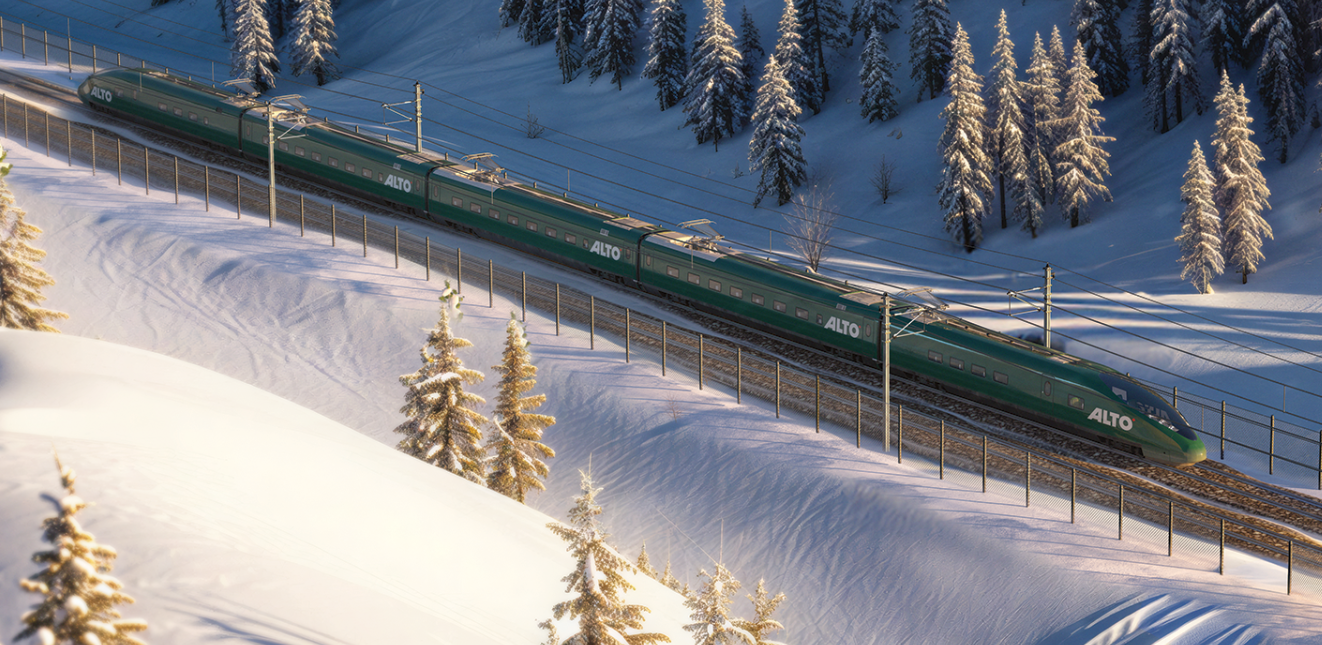
With speeds reaching 300 km/h or more on approximately 1,000 km of dedicated and mainly electrified tracks, Alto will connect millions of people living along the Toronto–Québec City corridor
© Alto
Infrastructure
Both high-speed and high-frequency rail require new infrastructure. Existing tracks, shared with freight trains, cannot support either system without affecting reliability.
A dedicated track is necessary for consistent service, whether the train is high-speed or high-frequency. The planned Alto network will operate on such separate tracks. Opting instead for a high-frequency service would not have altered the need to invest in this new infrastructure.
Travel Time
High-frequency rail would run at speeds of 160–200 km/h. By contrast, the Alto high-speed trains will operate at more than 300 km/h, connecting Montréal to Toronto in around three hours, and Québec City to Montréal in approximately one and a half hours.
Analyses indicate that travel times are key to influencing passengers’ choice of transport. International experience suggests high-speed rail can shift travellers from road and air to rail, supporting more efficient use of the transport network and reducing greenhouse gas emissions.
Economic Assessment
The initial construction cost of high-speed rail is estimated at 20–30% higher than high-frequency rail. Forecasts indicate that the broader economic impact of high-speed rail is greater, potentially increasing Canada’s GDP by 24.5 billion CAD (1.1%) compared with a 0.2% increase from HFR. The HSR project is also expected to create approximately 10,000 more jobs during construction.
Once operational, ridership is projected to increase up to thirteen times current levels on conventional routes, which could help offset ongoing operational and maintenance expenses. Existing rail services currently require about 297 million CAD annually in government support.
Combining Speed and Frequency
The Alto project is designed to offer frequent departures alongside higher speeds. Once fully operational, passengers travelling between Toronto, Ottawa, Montréal, and Québec City will have more options for scheduling trips.
Officials emphasise that the choice was not a matter of prioritising speed over frequency. The network aims to provide both, improving convenience for travellers while addressing long-term mobility needs.