DSB has contracted a consortium made up of Siemens Mobility and Stadler Rail to deliver at least 226 fully automated S-tog trains for Copenhagen’s rail network.
The contract covers the supply and maintenance of the new electric train sets, with the first trains expected to enter service in 2032. The project marks a transition to fully automated operation across the S-train network, which has been in service for more than 90 years.
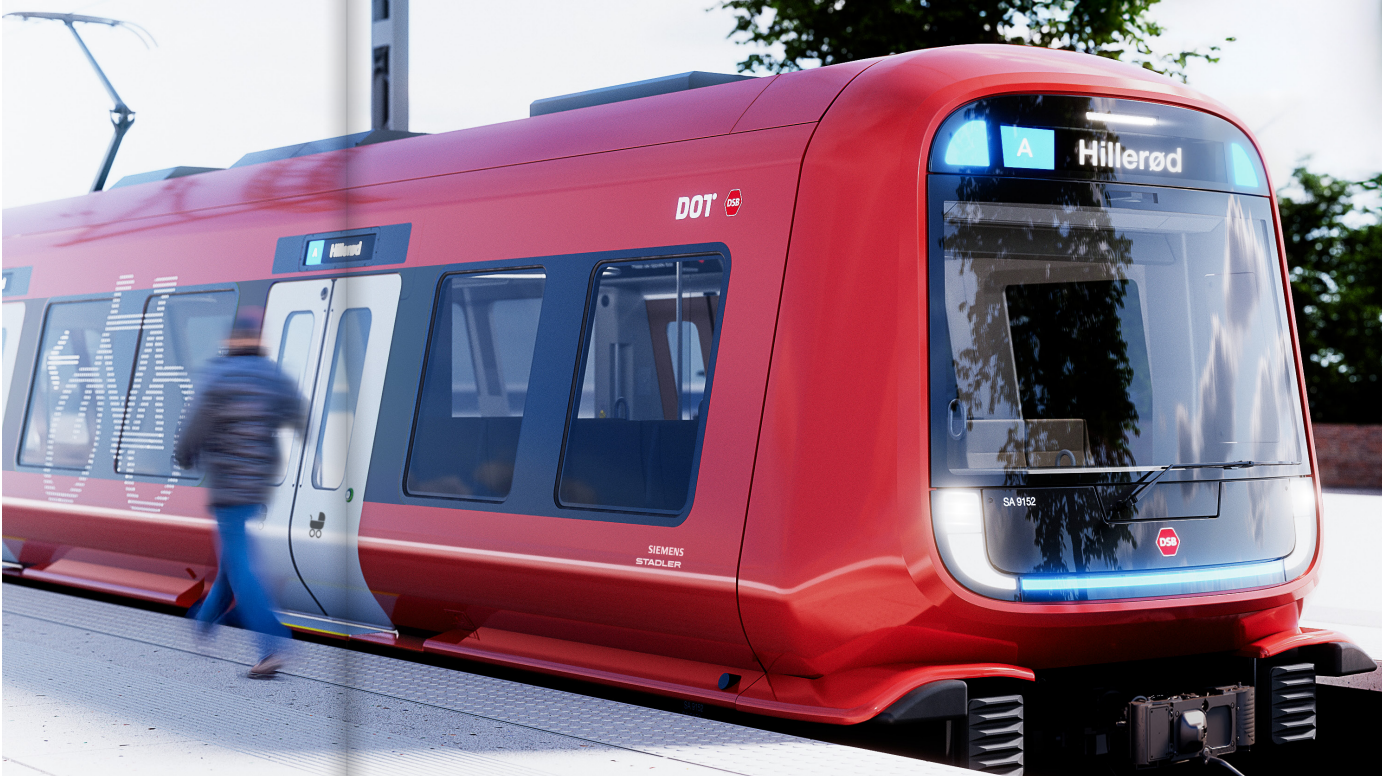
The new trains will run at speeds of up to 120 km/h
© DSB
According to DSB, the move to automated trains will allow more frequent services, particularly during peak hours. The plan is to reduce headways to a maximum of seven and a half minutes on each line during rush hour, and to as little as one and a half minutes on the central section between stations such as Copenhagen Central Station and Nørreport.
On several routes, this will mean up to 35 percent more departures than today. DSB estimates that the increased capacity will accommodate around 10 million additional passenger journeys per year. In 2024, the S-train network carried approximately 112 million passengers, and demand is expected to continue rising.
Peter Schütze, Chairman of the Board of Directors of DSB said:
The new fully automated S-trains are an investment in the future of public transport for the capital. With higher frequency and increased capacity, we ensure that the S-train can keep up with the growing demand and maintain its role as the backbone of the capital’s public transport.
The new S-tog trains will feature a range of interior layouts. These include 2+2 seating, air conditioning, work areas with tables, and integrated spaces for wheelchair users. There will also be flexible areas for bicycles and large luggage.
Each train set will be 56 metres long, made up of four carriages, and capable of operating in multiple sets. The trains will have a top speed of 120 km/h.
The consortium will also be responsible for maintaining the trains over a 30-year period. While Siemens Mobility and Stadler will hold overall responsibility for maintenance, the work itself will be carried out by DSB employees. The total value of the contract, including long-term maintenance, is approximately 23 billion DKK (3 billion EUR).
The first trains are planned to operate on line F, running between Copenhagen South and Hellerup, from 2032. Full automation of the entire S-train network is expected to be completed around 2040.
The procurement process for the driverless S-trains began in August 2023, following a political decision included in the Infrastructure Plan 2035 adopted in June 2021.
Siemens Mobility and Stadler Rail have previously worked together on projects such as S-trains for Berlin’s S-Bahn and the modernisation of Lisbon’s metro. Both companies also have experience in Denmark, including rolling stock, signalling, electrification and light rail projects.