Rail transport systems are becoming increasingly software-defined. Modern passenger rail environments now rely on interconnected operational technologies that include automated door controls, digital passenger information systems, predictive diagnostics, remote monitoring and integrated fleet management infrastructure. These technologies improve efficiency and operational visibility, but they also increase dependence on electronic systems within safety-critical environments.
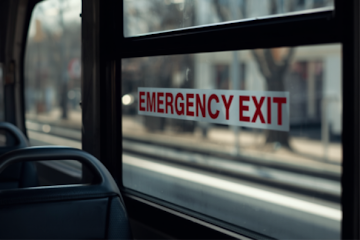
While rail systems are governed by different regulatory frameworks than buses and coaches, the engineering principles emerging from UNECE Regulation No. 107 Rev.10 offer important lessons for the wider public transport sector. The amendments strengthen requirements around emergency evacuation systems by emphasising operational reliability during degraded conditions. Emergency devices must remain visible, immediately accessible and capable of functioning even during power supply failure. The regulation also requires that emergency glazing systems can be broken and removed within defined time limits by a single passenger.
Although these provisions apply specifically to M2 and M3 passenger vehicles, the underlying philosophy is increasingly relevant to rail transport. As trains become more digitally integrated, emergency egress systems face many of the same challenges associated with electronic dependency, including power disruption, systems failure and operational complexity during emergency conditions.
Modern rail systems increasingly rely on electronically integrated infrastructure to coordinate communications, passenger movement, operational monitoring and onboard safety functions. During degraded conditions involving smoke, fire, electrical faults or infrastructure disruption, these interconnected systems may become partially unavailable or experience operational instability. In such environments, emergency evacuation capability must remain dependable regardless of the condition of the wider digital environment.
This broader resilience philosophy also aligns with principles reflected in ISO 26262-1:2018, which emphasises functional safety, fault tolerance and maintaining safe outcomes during electrical or electronic system failures. While developed for road vehicles, the underlying engineering approach reinforces an increasingly important principle across public transport sectors: safety-critical systems must remain dependable even when primary infrastructure becomes compromised.
Mechanical emergency egress systems such as Safe-T-Punch™ provide an important layer of resilience within these environments. Because they function through direct physical action rather than software logic or external power availability, they remain operable during conditions that may affect wider onboard systems, preserving a stable and independent means of escape when digitally dependent infrastructure fails.
LINKS
Learn more – https://unece.org/sites/default/files/2022-02/ECE_TRANS_WP.29_2022_53E.pdf
Find out more – https://safe-t-punch.co.za/
This article was originally written by Safe-T-Punch.