For manual track maintenance, ROBEL’s ROTAMP product line offers a comprehensive portfolio of vertical tamping machines covering a wide range of application requirements. Common to all models is ROBEL’s proprietary vertical vibration tamping principle, which ensures optimum ballast compaction beneath the sleeper and effectively corrects track level defects. A single sleeper can be tamped in approximately two minutes.
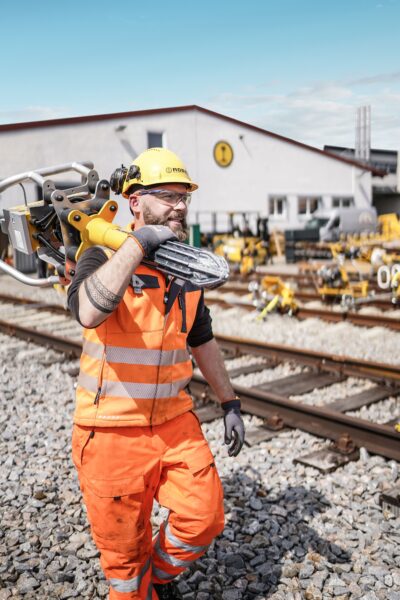
Man in hi-vis carrying a tamping machine on his shoulder by railway track
© ROBEL
In the conventional segment, ROBEL offers both 2-stroke and 4-stroke powered variants, most notably the ROTAMP 62.05CC for demanding continuous operation. The machine delivers optimum ballast compaction, a high load-bearing capacity of the track bed through tightly interlocked ballast, and minimum hand-arm vibration thanks to its patented 2-level vibration decoupling — available in multiple versions to suit different site conditions. For challenging environments such as hard-to-reach areas or heavily compacted ballast beds, the ROTAMP 62.05L rounds out the combustion-engine range with further variants including shorter or height-adjustable handles and reduced tamping tool diameters for heavily soiled ballast.
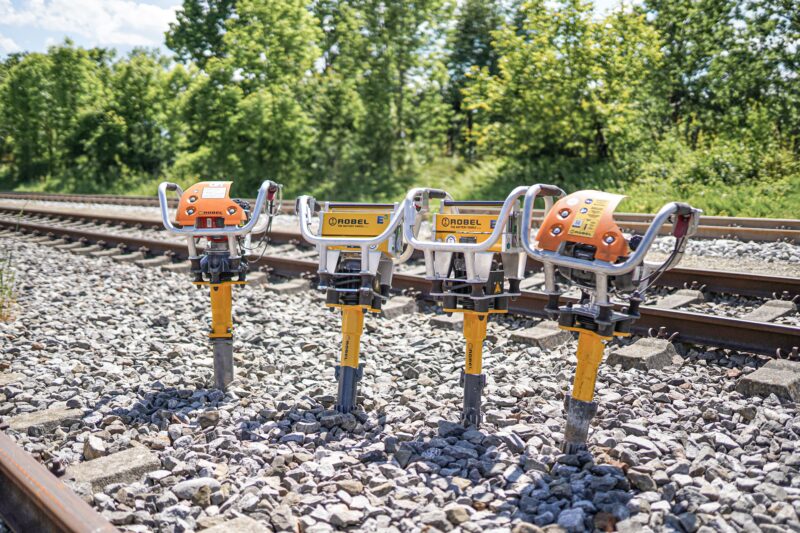
ROBEL ROTAMP Vertical Tamping machines by railway track
© ROBEL
As a fully emission-free alternative, the ROTAMP 62.20L E³ completes the portfolio. The battery-powered model operates without exhaust fumes and with low noise emissions, while delivering minimal hand-arm vibration through the same patented 2-level vibration decoupling system and benefiting from a low machine weight that relieves the operator. It is therefore ideally suited for tunnels, urban environments, or wherever strict noise and emission requirements apply.
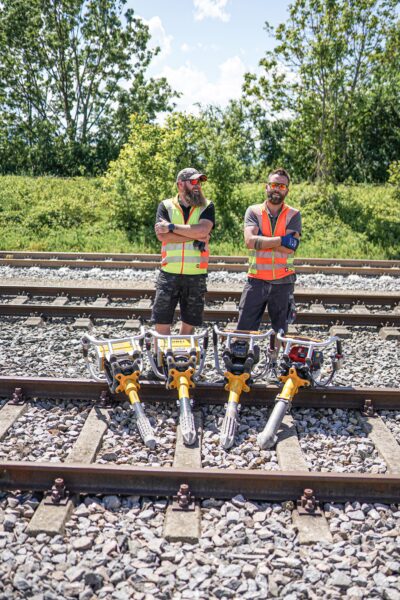
Two men stood behind four ROBEL ROTAMP Vertical tamping machines on railway track
© ROBEL
With this three-tier offering — spanning 2-stroke, 4-stroke, and battery-powered solutions — ROBEL covers the full spectrum of modern manual tamping technology, providing the right tool for every track maintenance challenge.
This article was first published by ROBEL.