How shifting passenger expectations are exposing a gap that existing technology could already close.
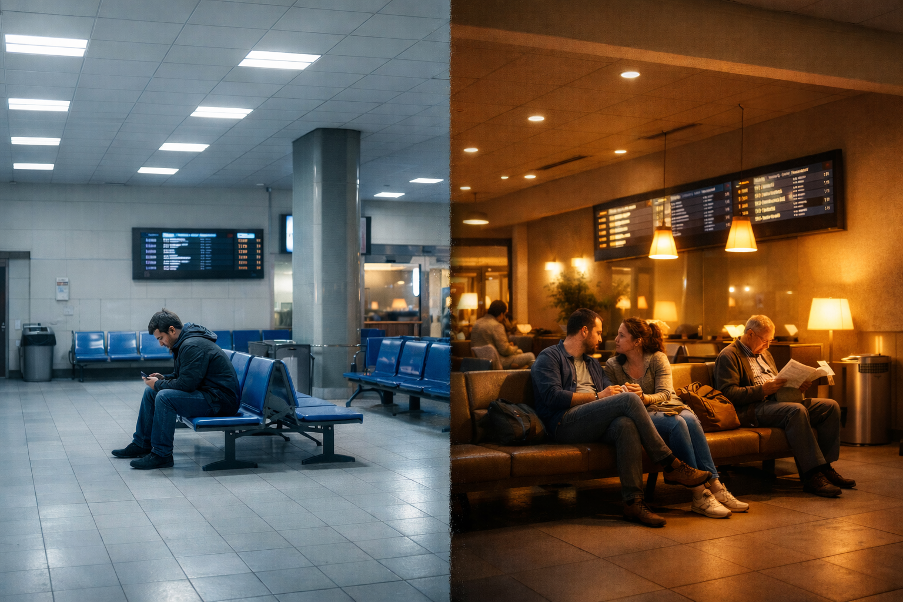
Passenger expectations are changing – rail lighting hasn’t kept up
© I-Vision Lighting Solutions
Across Europe, smart home technology is no longer niche. Around 30% of households now have some form of connected home system — roughly 73 million homes.1 In the United States, adoption approaches half of all households.2 Across the EU, more than 70% of people use at least one internet-connected device.3
Full adoption is not the key shift. Exposure is. Even limited use — automated lights, app-controlled lamps, or occupancy-based switching — introduces a different reference point for how environments can behave. More people are encountering spaces that respond, at least some of the time, to presence, time of day, or user preference.
Standards such as Matter are intended to address two of the barriers that have historically limited wider adoption: interoperability between devices and ecosystems, and the cost penalties that come from fragmentation.4 By enabling devices from different manufacturers to work together, Matter creates the conditions for economies of scale that have so far eluded the sector. If successful, this is likely to accelerate adoption meaningfully.
This does not create a uniform expectation — but it does shift the baseline. Passengers do not necessarily expect “smart lighting” in rail environments, but they are increasingly aware of when spaces feel responsive — and when they do not.
Where Rail Lighting Falls Short
Rail lighting systems are designed first and foremost to meet safety requirements, alongside being predictable, robust, and straightforward to maintain. These priorities are entirely appropriate in infrastructure environments.
In practice, however, this emphasis produces systems that are fixed in output, uniform over time, and largely unresponsive to occupancy or changing conditions. Platforms can feel overly bright late at night; waiting areas remain dim during busy periods. Lighting rarely distinguishes between transient movement and prolonged dwell time. This is a consequence of systems optimised for compliance, not responsiveness.
Why This Matters
Lighting has a direct influence on how spaces are perceived. It contributes to a sense of safety, affects comfort during dwell time, and shapes the overall experience of a journey.
Small mismatches accumulate. Spaces that are too bright can feel harsh; those that are too dim feel unwelcoming. Passengers may not consciously attribute these impressions to lighting, but they experience the effects nonetheless. In a sector increasingly focused on passenger experience, this represents a missed opportunity.
The Experiential Gap
Commercial lighting systems are typically engineered to deliver defined performance: compliance with standards, uniformity, efficiency, and reliability. This focus can result in environments that feel functional rather than comfortable.
By contrast, many environments passengers now encounter elsewhere — at home, in hospitality, in retail — place greater emphasis on how lighting feels. Subtle variation, responsiveness, and contrast are used to shape atmosphere as well as visibility. The difference is not one of capability, but of intent.
The Capability Already Exists
The capabilities required to create more responsive environments are not new. Occupancy sensing, daylight response, and time-based control have long been available within systems such as DALI. What has changed is the context in which lighting is experienced.
Research in building science and environmental psychology supports this shift. Studies have shown that lighting influences not only visual performance but also how spaces are perceived — and that occupancy- and daylight-responsive control can be achieved while maintaining required illumination levels.5
Lighting can be tuned to reflect time of day, respond to occupancy patterns, distinguish between transient movement and longer dwell periods, and transition gradually rather than abruptly. These are incremental changes, but they materially affect how a space feels — and they build on established control principles rather than replacing them.
The Real Challenge: Application, Not Technology
If the capability already exists, the question is why it is not more widely used. The barrier is rarely hardware. It lies in how systems are specified, how they are commissioned, and how behaviour is defined at handover. Lighting is often treated as fixed infrastructure, with limited scope for adjustment once installed.
This contrasts with the environments passengers encounter elsewhere, where behaviour is expected — at least occasionally — to adapt over time.
A Measured Evolution
Rail environments will always require predictability, reliability, and, above all, safety. Any lighting system must consistently meet defined illumination levels and visibility requirements under all conditions — these are non-negotiable.
Within those constraints, there is scope to move beyond entirely static behaviour. Carefully controlled adaptability — occupancy response, time-of-day adjustment, gradual transitions — can be introduced without compromising safety, provided that minimum lighting levels and critical visibility are always maintained. The challenge is disciplined application: defining where adaptability adds value, and where consistency must remain absolute.
Conclusion
Passenger expectations are not being set by rail. They are being shaped elsewhere — gradually, unevenly, but increasingly.
Lighting is one of the most immediate ways those expectations are either met or missed.
The industry already has the tools to respond. The question is whether it chooses to use them. The future of rail lighting may not depend on new technology, but on applying existing capability in ways that better align with how passengers increasingly expect spaces to behave.
References
- Smart home market in Europe and North America (2024–2029). EE News Europe. https://www.eenewseurope.com/en/smart-home-market-in-europe-and-north-america-set-for-double-digit-growth/
- North America and European Smart Homes and Home Automation Research Report 2024–2029. Business Wire / ResearchAndMarkets. https://www.businesswire.com/news/home/20251114161338/en/
- Internet connected devices usage across the EU. Eurostat (2025). https://ec.europa.eu/eurostat/web/products-eurostat-news/w/ddn-20250828-2
- Matter is an open-source connectivity standard developed by the Connectivity Standards Alliance (CSA), backed by Apple, Google, Amazon, and others. See: https://csa-iot.org/all-solutions/matter/
- Boyce, P.R. (2022). Light, lighting and human health. Lighting Research & Technology. https://journals.sagepub.com/doi/10.1177/14771535211010267. See also: Cuttle, C., Boyce, P., Raynham, P. & Kelly, K. (2020). Lighting: We’re doing it all wrong. Lux Review. CIBSE Lighting Guide LG7 also provides relevant guidance on adaptive lighting in interior environments.