What is happening?
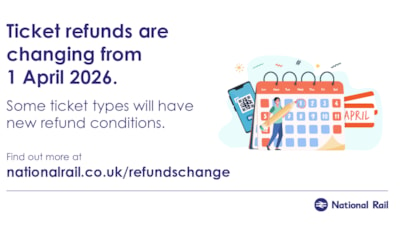
- From 1 April 2026, the following tickets, Anytime, Off-Peak, Day Travelcards and most Ranger and Rover tickets, will no longer be refundable on the day they become valid for travel.
- Self-serve automated refunds will only be available for tickets that have not yet become valid for travel with other refund requests being subject to additional checks.
- Refunds will continue to be available for customers who cannot travel because of disruption or cancellation. Rail retailers will also continue to consider claims from customers who are prevented from travelling because of exceptional circumstances such as medical emergencies, which will be considered on a case-by-case basis.
- Passengers who purchase Advance tickets and Season Tickets will be unaffected, as these tickets already have their own refund conditions.
- The new changes bring Britain in line with other countries’ railways and other transport sectors, where refunds are not generally available once a ticket is valid for use.
Why is it happening?
- The rail industry is updating the National Rail Conditions of Rail Travel to end refund abuse, saving farepayers and taxpayers £40 million a year, and to modernise a system that no longer reflects how people travel today.
- This is one of a number of measures being implemented by the rail industry to tackle fraud following an independent review by the Office of Rail and Road in 2025, carried out as part of wider Government action to tackle fare evasion, which currently costs the railway up to £400 million each year.
- Refund abuse, where someone claims a refund for a ticket they have already used by falsely stating they did not travel, is estimated to cost the railway around £40 million annually.
- This is a legacy of the outdated refund system that was designed for an era of paper tickets and cash payments, which allowed customers 28 days to return to the station that sold them their ticket to request a refund. Today, however, more than 80% of customers use digital tickets or tap in with payment cards or smart devices, and most refund claims are handled through self-serve processes online. The outdated rules in recent years have become a significant source of fraud and misuse.
What qualifies as “exceptional circumstances”?
- These are situations where a customer could not travel for reasons genuinely beyond their control for example serious medical emergencies or unexpected events that prevented travel.
- These will be assessed on a case-by-case basis and if a customer has a valid reason for not using their ticket and cannot request a refund before the day of journey, retailer Customer Relations teams will be able to consider a refund.