As operators push for higher safety, efficiency, and automation, radar-powered systems and AI are reshaping long-range perception in rail, enabling trains to ‘see’ beyond human and camera-based vision. Vicky Alman, CEO of NIART Systems, explores how these technologies enable trains to ‘see’ beyond the limits of human and camera-based vision.
Rail operators today are caught between two opposing forces: the push for increased capacity and the uncompromising requirement for safety. In the day-to-day reality of the cab, these pressures collide when visibility drops. Whether it is dense fog, heavy snow, or the blinding glare of a low sun, operational certainty diminishes the moment the human eye, or a standard camera, loses its range.
Long-range perception has an important role to play in reducing these challenges, as it enables train drivers to detect hazards earlier, operate more safely in all conditions and maintain optimal performance even when visibility is compromised. It’s also a key enabler of greater automation, supporting the industry’s move towards more automatic train operation (ATO).
With that, many current means of detection have their limitations. For example, human vision is simply not designed for the distances required in rail, where braking distances can approach ten times the stopping distance of a car when travelling at 100km an hour. Train drivers and signallers are acutely aware of how quickly risk increases the moment visibility lowers: breaking curves must be extended, reaction times shorten and operational certainty diminishes. Then there’s the impact of poor weather and environmental conditions, as fog, heavy rain, snow and low sun etc can reduce visibility to just a few hundred metres or less. Under poor visibility, the safety margin operators rely on becomes much harder to guarantee.
Today, radar, LiDAR, and cameras are the three primary sensor modalities that provide alternative sensing envelopes as inputs to perception systems in driver assistance and autonomous driving applications. Systems based exclusively on LiDAR or camera technology suffer similarly, because they rely on the same optical physics, and their performance degrades under adverse environmental and visibility conditions where it’s most critical. In fog, for example, both the driver and optical sensors may struggle to perceive beyond a short distance, while glare, darkness and rain can further degrade image quality and classification accuracy. From an operational standpoint, this translates to speed reductions, cautious driving and reduced ATO capability.
A Reliable Backbone for Long-Range Perception
Radar-powered systems overcome the challenges of adverse weather, poor lighting and visibility, providing consistent long-range hazard awareness in all conditions. When coupled with AI and effectively fused with optical sensors, these radar-based solutions can then further improve target detection and classification, while reducing false alarms.
Adapted from aerospace and defence-grade techniques, radar-based perception has lately evolved into a mainstream technology in automotive safety. Take, for example, the features of advanced driver assistance systems (ADAS) such as autonomous emergency breaking (AEB) or side blind zone alert (SBZA) systems.
Having matured in the automotive industry, radar-based solutions are now being realised as a game-changer for rail. This is because radar uses millimetre wave frequencies to scan the path ahead and can provide an accurate picture of a clear path and of potential obstacles at both short distances and long ranges of over 1,000m. It can be relied on in both daylight and low light conditions without degradation, and can also penetrate dense fog, rain and snow with relatively small impact on performance.
For operators the advantage is clear: radar delivers hazard awareness under exactly the conditions where optical systems – and human vision – are least effective. This makes it uniquely suited for maintaining safe running at line speed during adverse weather.
AI as a Booster
While radar inherently provides the robust long-range, all-weather sensing backbone required for rail operations, physical AI adds an additional intelligence layer, turning raw radar signals into enhanced perception.
Modern systems pair classical radar signal processing, e.g. range and doppler processing, angular estimation, CFAR detection and tracking with physical AI, enabling the system to extract the structural and behavioural signatures of potential hazards and the environment. This fusion, along with optical sensors, allows for better target detection, position estimation and classification of obstacles such as debris, vehicles, pedestrians, animals, rockfalls or track obstructions at ranges that preserve safe breaking margins.
AI interprets complex radar echoes, extracting structural, geometric and behavioural cues from the raw data that classical processing alone cannot fully capture. By learning the characteristic signatures of pedestrians, animals, vehicles, debris and/or rockfalls and clutter, physical AI models as an ‘AI on top physics’ increase the confidence of detection and hazard classification, while filtering out false positives caused by clutter, multipath reflections or other noise.
This level of fidelity is essential for driver acceptance and operational integration. A perception system must do more than just detect hazards – it has to do so reliably, consistently and without overwhelming operators with false information.
Predictive Maintenance and Asset Condition Monitoring
Beyond safety and hazard detection, the same radar, optical and AI-based sensing stack also enables a distinct set of asset management and maintenance applications.
In this context, AI supports predictive maintenance and track-condition monitoring by learning what a ‘healthy’ track looks like, identifying early signs of degradation such as buckling, deformation or near-tracks environment change patterns and flagging emerging issues before they escalate into failures or disrupt operations. For infrastructure managers, this translates into earlier intervention options, more stable workbanks and fewer unplanned outages.
Clear Operational Benefits
These technologies’ robust capability delivers clear operational benefits, including improved punctuality and timetable resilience and reducing congestion ripple effects – especially on high density or mixed traffic routes.
Its capabilities also lay the foundation for full automation. Radar’s immunity to lighting and its minimal degradation in poor weather make it the essential backbone for ‘all visibility’ autonomy, while AI enhanced capabilities also support the fusion with other sensing modalities required to reach safety-critical confidence thresholds.
A Digital Sixth Sense for Rail
Together, radar and physical AI deliver something rail has never truly had before: a long-range, all-weather, always-on digital lookout – a technical ‘sixth sense’ that supports safer, faster and more reliable operations today, while creating a future-ready platform for the autonomous rail networks of tomorrow.
All-Visibility Safety for Rail Operations
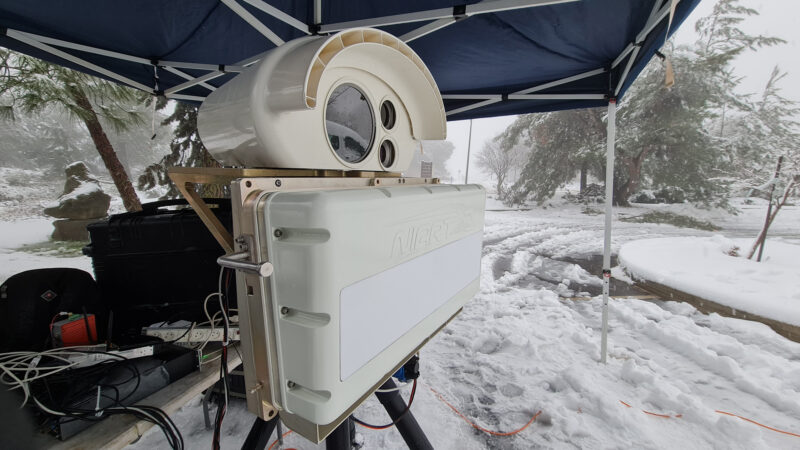
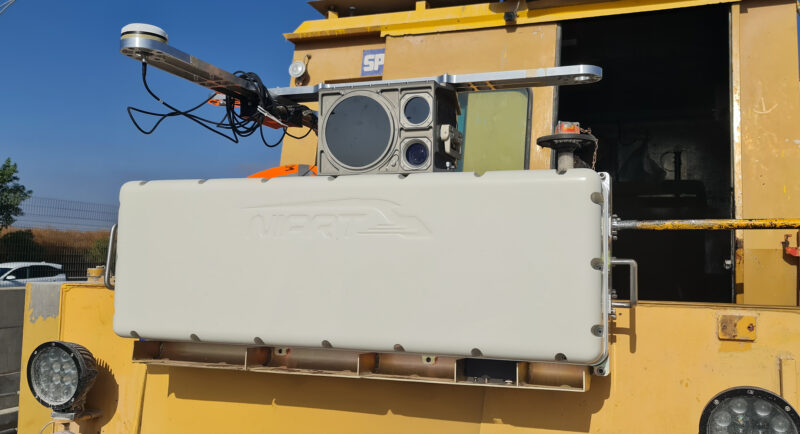
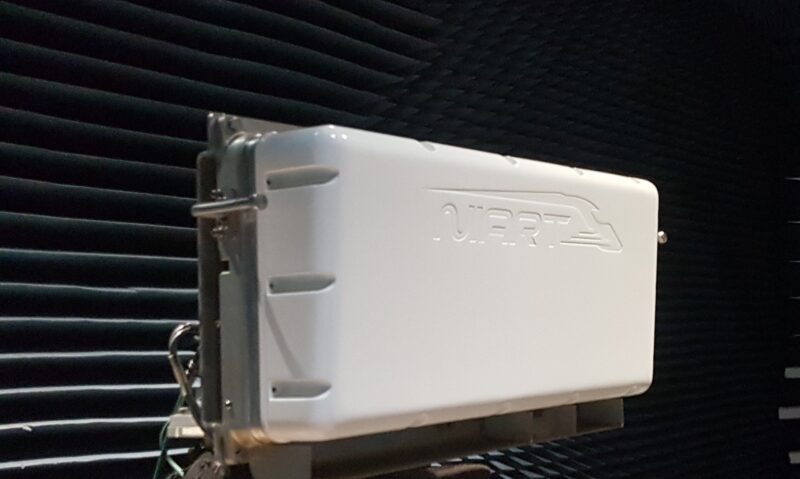
NIART Systems has developed a multi-sensor, all-weather perception platform, designed to deliver long-range hazard detection whatever the visibility conditions.
The system fuses high-resolution radar, multi-spectral electro-optical cameras (thermal and daylight), AI-driven perception and advanced data-fusion algorithms to generate real-time, actionable alerts for drivers or ATO systems.
Long-range optical sensors along with the radar can detect obstacles at distances exceeding 1,200 metres. The solution also identifies key rail infrastructure, such as switches and signals, enabling deployment across mainline, freight, passenger or shunting operations.
This system is already proving its capabilities in demanding environments. On Indian Railways, it’s currently undergoing trials on diesel and electric locomotives as a driver assistance solution for hazard-loaded environments and extreme winter fog corridors. Despite severe visibility loss, the system maintains reliable obstacle detection for over 1200m distance, offering a practical solution to one of the network’s most persistent operational challenges.
In Europe, it’s integrated into Alstom’s ATO for a join autonomous shunting programme with ProRail and Lineas. Here, it’s consistently identified and alertyed on cars, people, wagons and misalaigned switches up to 600m. This demonstrates both the maturity of NIART’s technology and its readiness to support Grade of Automation 4 (GoA) automation.
Contact NIART Systems to find out more about this solution.